
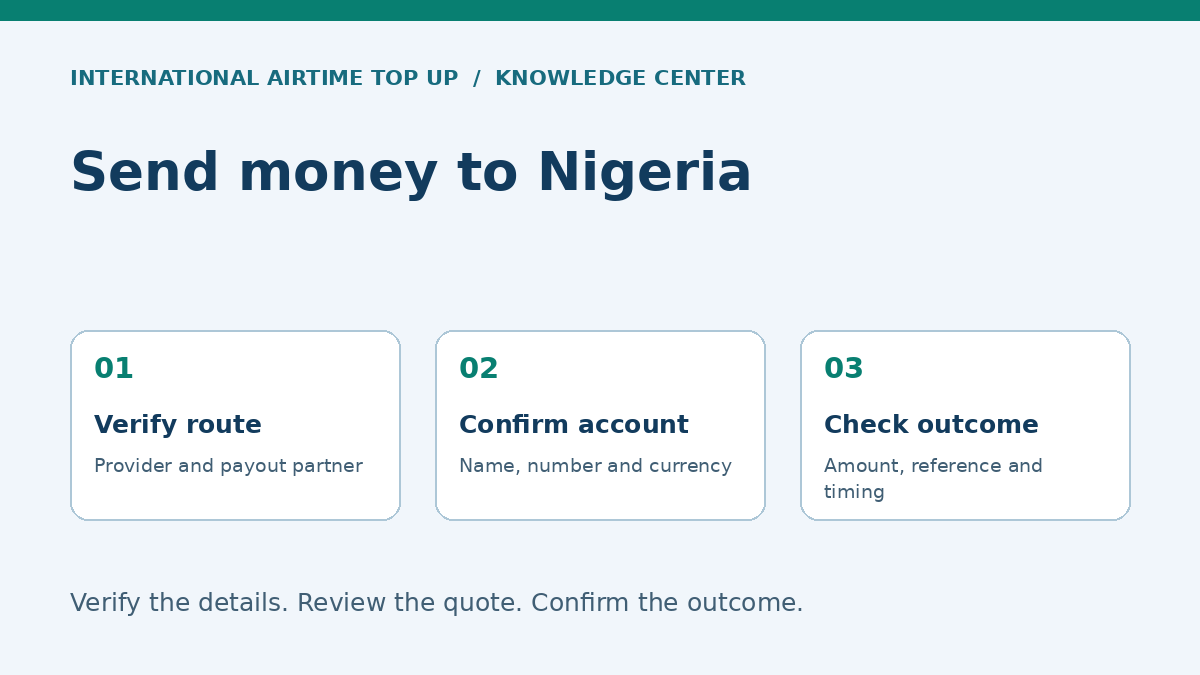
Sending money to Nigeria: begin with the recipient's actual need
The practical question is not simply how to move money to Nigeria. It is how to deliver the correct amount, in the correct currency, to an account or payout point the recipient can use, within a realistic timeframe. A parent paying school fees, a worker supporting family and a business settling an invoice may need different arrangements even when they send the same amount.
Start by asking whether the recipient needs a bank credit, an available cash-pickup service or another specifically supported method. Confirm the sending country and the provider's current Nigeria route before comparing price. A platform operating internationally does not automatically support every origin, Nigerian bank, account type or payout option.
This guide concerns legitimate inbound transfers to Nigeria. It does not establish a provider's authorisation, promise a particular payout currency or replace current regulatory and provider requirements. Worked figures and scenarios are illustrative. The broader payout-method guide explains the differences between bank, wallet and cash receipt.
Check the regulated route and the legal entity
The Central Bank of Nigeria publishes a list of licensed International Money Transfer Operators. Use the current official record to check the relevant legal entity and ask the sender-side service which Nigerian payout partner handles the transaction. A brand name, company registration or app-store listing alone does not establish the full regulatory position. Source: CBN's IMTO register.
Where a service uses partners, distinguish the company taking your payment from the institution making the Nigerian payout. Ask who issues the receipt, who investigates a delay and where a complaint should be submitted. Do not infer that International Airtime Top Up or any named brand has a particular licence from this educational article; verify the actual transaction arrangements.
Rules and approved arrangements can change. Before a substantial transfer, confirm the supported purpose, recipient type, payout currency and documentation. A personal family-remittance route may not be appropriate for a commercial invoice, investment or specialised payment. Do not misdescribe the purpose to obtain access to a cheaper or faster route.
Which delivery methods should you compare?
| Method | When it can fit | What to verify |
|---|---|---|
| Nigerian bank deposit | Family support, a usable personal account or an accepted institutional payment. | Bank, account name, number, currency, account eligibility and reference. |
| Cash pickup where offered | The recipient needs physical cash and can reach an authorised location. | Current availability, payout currency, accepted ID, amount restrictions and opening hours. |
| Other digital payout where explicitly supported | A named eligible service meets the recipient's needs. | Current route approval, account type, recipient registration and limits. |
Do not assume a Nigerian mobile number is itself a mobile-money destination. A transfer app may request a phone number for contact while paying a bank account. Airtime recharge is also not a remittance: if the recipient needs communications credit instead of money, use the Nigeria airtime guide.
Bank deposit is often convenient when the recipient can spend or withdraw from the account. Cash pickup should be assessed at the actual branch or agent level, not only by a provider's national coverage claim. Confirm details before the recipient makes a costly journey.
Recipient information for a bank transfer
Obtain the account holder's name, bank name and account number directly from a trusted recipient or institution. Copying details from an old message can be risky if the account has changed. The name shown by any available verification service should be consistent with the intended beneficiary; investigate an unexplained mismatch.
Some routes require additional bank identifiers, address information or a transfer reference. Follow the selected provider's instructions rather than inventing a SWIFT/BIC code or substituting a code found for another branch. A domestic account-transfer form and an international wire form may request different fields.
The recipient should confirm that the account is active and able to receive the proposed transaction. An account restriction, identity-record issue or currency mismatch may prevent normal receipt. The sender does not need the recipient's bank password, card PIN or one-time code to send legitimate funds.
For institutional payments, ask for the exact reference needed to reconcile the credit. A school may require a student number; a hospital may use a patient or invoice reference. Money arriving in the right account without the correct reference can still leave the intended obligation unresolved.
Payout currency and exchange rates
Confirm the recipient currency on the current quote. NGN means Nigerian naira. Do not assume that paying in pounds, euros or dollars means the recipient receives that same currency. Equally, do not assume that a foreign-currency account is supported by an ordinary consumer remittance route. Ask the bank or provider about the correct account and service.
Compare the total sender payment and expected recipient amount at approximately the same time for the same route. A small advertised fee can be offset by a less favourable exchange rate. Some quotes fix the recipient amount subject to conditions; others may change if funding arrives after a rate guarantee expires.
The World Bank's remittance-cost explanation identifies transfer fees, exchange-rate margins and possible recipient charges as distinct components. Use that framework rather than selecting on the visible fee alone. Source: World Bank Remittance Prices Worldwide.
An illustrative Nigeria quote comparison
Suppose a sender has a total budget of 200 sending-currency units. Two fictional providers quote the same bank-deposit destination at the same time. Provider A converts 200 at an illustrative rate of 1,500 NGN per unit with no separate fee, producing NGN300,000. Provider B deducts a 2-unit fee from the budget and converts 198 at 1,530, producing NGN302,940.
Provider B delivers NGN2,940 more in this example despite charging a visible fee. These are invented teaching rates, not current market prices. The comparison would change if fees were added rather than deducted, a different funding method applied or another charge reduced the recipient credit.
For an invoice requiring an exact naira sum, request a quote based on the recipient amount if the service permits it. Confirm whether potential deductions are covered. Avoid rounding the sender amount and hoping the converted result satisfies a formal payment deadline.
Step-by-step: preparing and sending the transfer
- Confirm the recipient, purpose and preferred accessible payout method.
- Check the service supports your sending country and the Nigerian destination.
- Verify the relevant legal entity and payout arrangement through official information.
- Collect recipient details and independently confirm any change from previous instructions.
- Obtain a live quote showing sender total, recipient currency, amount and delivery conditions.
- Complete legitimate identity and payment checks through the official account.
- Review every field before authorising payment and save the receipt.
- Track the transfer and ask the recipient to confirm the actual credit or authorised collection.
Send from a funding source permitted by the provider. If someone else is contributing, ask the provider how to handle that legitimately instead of using another person's card without understanding the rules. Accurate identity and source information makes a review easier to resolve.
Timing, weekends and recipient-bank processing
An available route may be fast, but a universal arrival promise is inappropriate. Funding delays, review, public holidays, partner availability and bank posting can affect the result. Save the transaction-specific estimate and note whether it begins only after funds reach the provider.
If the recipient is waiting for rent, tuition or a medical invoice, allow time for reconciliation and correction as well as transfer movement. A bank alert is useful but the account ledger or statement provides stronger confirmation. Avoid treating a forwarded screenshot as proof of cleared funds.
If the estimate passes, ask the provider which stage is incomplete. The recipient may need to contact their bank with the reference supplied by the provider. Do not keep resending the same amount while the first transfer remains unresolved. The transfer-timelines guide explains how to investigate delays.
Requirements, limits and larger transfers
Requirements can depend on sending jurisdiction, provider, amount, recipient type, funding source and purpose. You may need identity documents, proof of address or an explanation of the funds. The recipient may also face account-specific checks. There is no single limit that can safely be applied to every Nigeria route.
For a large legitimate payment, ask about the documentation and route before the deadline. Confirm whether the transaction belongs on a personal-remittance service or a specialised bank or business-payment channel. Tax, property and commercial questions may require professional advice beyond a transfer provider's checkout support.
Do not break a payment into smaller parts to avoid verification or reporting requirements. If a provider's limit does not fit the purpose, ask about an authorised alternative. Smaller repeated transactions can also create additional fees and reconciliation problems without resolving the underlying eligibility issue.
Nigeria-focused practical scenarios
Monthly household support
A sender supports a parent who actively uses a Nigerian bank account. They compare ordinary pricing rather than only the first-transfer promotion, verify the account is unchanged and budget around the naira amount the household needs. They retain references so both sides can distinguish the monthly payment from unrelated credits.
Tuition with a student reference
A university supplies verified bank instructions and a required student identifier. The sender checks whether the service allows that reference and whether it supports payment to the institution. If not, they obtain appropriate banking instructions instead of forcing an institutional payment through a personal beneficiary form.
A changed account after an urgent message
A relative requests payment to a new account and says the old one is unavailable. The sender independently calls the relative on a known number before changing the beneficiary. This check protects against both an honest account problem and a compromised messaging account.
A recipient without convenient banking access
Cash pickup may be worth investigating, but the sender confirms a supported location, acceptable identification and current amount rules before paying. The recipient's transport cost and safety are part of the decision. An unavailable or distant agent is not a useful alternative merely because a website lists Nigeria.
Common errors and how to respond
Incorrect details should be reported immediately through official support. Ask whether the transfer is still pending, already credited or being returned. A completed payment to a valid but unintended account may be difficult to recover; no article should promise that a name mismatch automatically causes rejection.
A reduced recipient amount should be checked against the quoted amount, currency and disclosed charges. Separate a poor exchange-rate comparison from an actual posting discrepancy. Keep the original quote and receipt so support can explain the calculation rather than reconstructing it from memory.
For a suspected scam, contact both the provider and the funding institution promptly. Preserve messages and references privately. Do not pay a stranger who promises recovery. Review the safe-sending checklist before the next payment.
A Nigeria transfer worksheet for exact obligations
For an important payment, write down the amount the beneficiary must receive, the required currency, the exact account holder, the deadline and the reference. Distinguish the deadline for bank credit from a school's or supplier's reconciliation deadline. An institution may need time to identify and allocate a payment after its bank receives it.
Next, record the sender total, exchange rate, fee treatment and any possible later deduction. Check whether the amount entered into the quote is the total budget or the sum converted before fees. Save the quote's expiry and the funding deadline. These details prevent a common misunderstanding in which the sender believes they ordered an exact amount but actually entered a pre-fee sending sum.
Finally, agree how the recipient will confirm receipt. For a bank credit, use the account ledger or a verified statement. For cash pickup, use the provider's collection status and the intended recipient's direct confirmation. A payment screenshot forwarded by someone else can be useful supporting information but should not replace verification of the actual beneficiary outcome.
When an intermediary suggests a different account
Sometimes a relative or informal helper offers an alternative account to make receipt easier. That may create a different legal and practical transaction: the funds now go to the helper, who must forward them. Before considering it, ask why the intended recipient's account cannot be used and whether the provider permits the arrangement.
Do not route funds through a stranger to avoid a bank restriction, identity check or provider limit. If the intended account is unavailable, obtain a legitimate alternative in consultation with the recipient and provider. Keep the real purpose accurate and ensure the receipt identifies the actual destination. An apparently convenient workaround can make a later dispute substantially harder to resolve.
Confirm the result before closing the record
The transfer is not administratively finished just because the sender has paid. Confirm the recipient's actual amount and currency, whether any expected reference arrived, and whether the intended obligation was satisfied. For a tuition payment, for example, obtain confirmation from the institution that the student's account has been credited, not merely that a bank transfer occurred.
For recurring support, record discrepancies promptly while the quote and transaction details are readily available. Compare like-for-like outcomes over time rather than interpreting every change in naira received as a service error: market rates, sender amount or funding method may have changed. Where the difference remains unexplained, raise a specific enquiry with the provider using the original receipt.
Frequently asked questions
What details are needed to send money to a Nigerian bank account?
Common details include the verified account name, bank and account number. Additional codes, purpose information or references depend on the selected route and provider.
Will the recipient receive the currency I paid with?
Not necessarily. Confirm the payout currency on the current quote and ensure the recipient account supports it. Do not assume a foreign-currency account is eligible for every remittance service.
Is cash pickup always available in Nigeria?
No. Availability, locations, identification and amount conditions depend on the provider and current arrangements. Confirm the exact route before paying.
Can I send to a Nigerian mobile number instead of an account?
Only where the provider explicitly supports an eligible destination service. A contact number or airtime balance is not automatically a money-transfer wallet.
What should I do if the bank details are wrong?
Contact official support immediately with the reference. Ask about the transfer status and correction or recovery options; do not assume cancellation is guaranteed.
Review your available options
Check the current destination, recipient requirements, total price and delivery conditions before confirming.
Explore available servicesSources and further reading
Information notice: General educational information, not individual financial, legal or regulatory advice. Eligibility, fees, exchange rates, limits, products and delivery conditions can change. Confirm the current provider and recipient requirements before payment. Illustrative figures and scenarios are not live quotations or customer case reports.