
How long does an international money transfer actually take?
An international transfer can become available quickly or require several business days, depending on the route, funding method, checks and receiving institution. The useful estimate is the one supplied for your specific transaction, not a general claim about an entire payment network. Before paying, establish when the recipient can use the money and what must happen before the delivery clock starts.
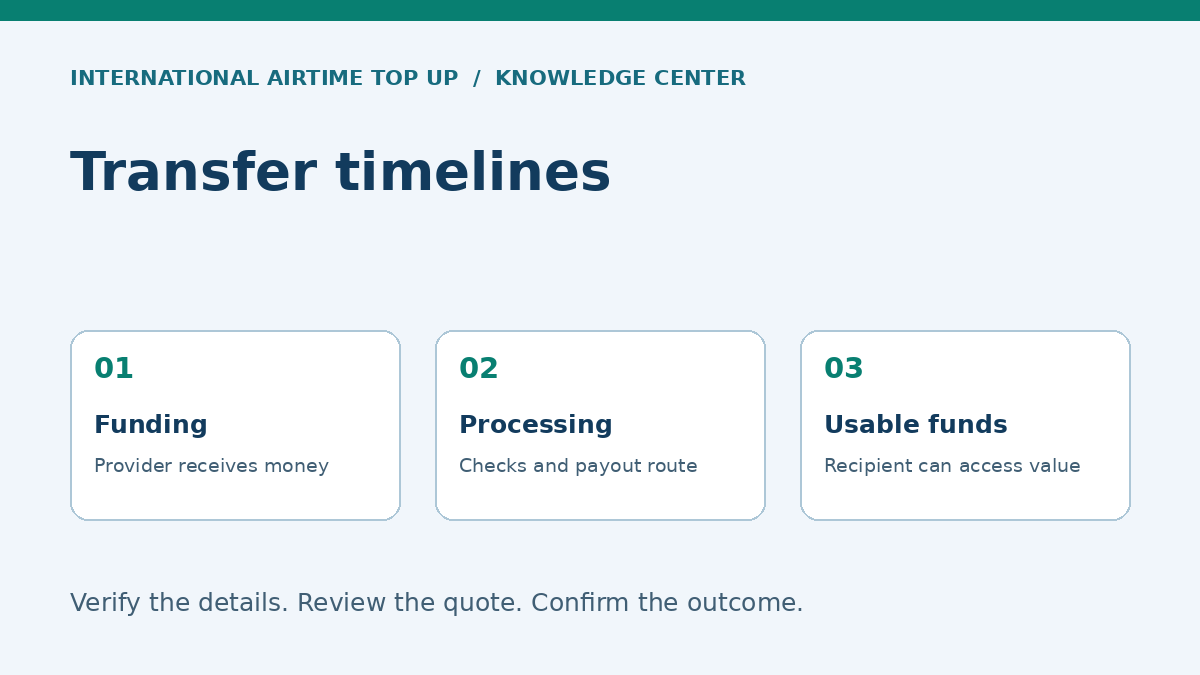
A sender may see “payment successful” while the recipient still has no usable balance. Those statements can both be correct: the provider may have collected the sender's payment but not yet completed the destination payout. Separating payment collection, processing, delivery and availability makes delays easier to understand and helps support teams investigate the right stage.
This guide explains timelines by delivery method without promising a universal arrival time. The examples below are illustrative planning scenarios, not provider quotations or documented customer cases. For the complete process, read how international money transfers work.
The four clocks behind a delivery estimate
The first clock is funding: how long the provider takes to receive usable money from the sender. A card authorisation may happen rapidly, while a bank-funded order can remain unpaid until the bank payment arrives and is matched to the correct reference. Starting a transfer in an app does not necessarily start its delivery estimate.
The second clock is verification and release. Identity checks, transaction review, payment authentication or clarification of recipient details may need to finish before the provider releases the transfer. A previously verified customer can still encounter a transaction-specific review. Checks should be answered accurately through the official account; they should not be bypassed by splitting payments.
The third clock is movement through the payment route. Depending on the service, this can involve a local payout partner, a mobile-wallet connection, correspondent institutions or a receiving bank. An electronic message may travel quickly even when settlement or posting requires further processing.
The fourth clock is recipient access. A bank may have received the instruction but not posted the credit; a cash location may be closed; a wallet may show funds that cannot immediately be withdrawn because the nearest agent lacks sufficient cash. Ask whether the estimate ends at partner receipt, account credit, readiness for collection or actual access.
Timelines by delivery method
| Method | Planning expectation | What can extend the wait? |
|---|---|---|
| Mobile wallet | May be rapid once funding and checks are complete; use the transaction-specific estimate. | Wallet limits, account restrictions, operator availability and incorrect numbers. |
| Cash pickup | May become ready quickly, but collection depends on the recipient and location. | Opening hours, accepted ID, cash availability, travel and name mismatch. |
| Bank deposit through a remittance provider | Can be fast on supported local payout routes; other routes require business-day processing. | Bank cut-offs, holidays, account validation and receiving-bank posting. |
| International bank wire | Allow for the bank's stated multi-stage processing window. | Intermediaries, currency conversion, compliance review and final account credit. |
This table is a planning framework rather than a quoted service level. A well-connected bank route can outperform a wallet route experiencing an outage. Cash pickup described as available in minutes may be unusable until tomorrow if the recipient's branch has closed. The payout-method comparison helps separate delivery speed from practical convenience.
Why fast network processing is not the same as fast account credit
Swift distinguishes the journey to the beneficiary bank from the final credit to the customer. Its payment-speed explanation reports that more than 90% of payments on its network reach the beneficiary bank within an hour. That figure does not mean every sender's bank transfer is available to the recipient within an hour. Funding, checks and the receiving bank's final processing can sit outside that measurement. Source: Swift's explanation of payment timing.
When asking a bank about a late transfer, distinguish “received by the beneficiary bank” from “credited to the beneficiary account.” Request the tracking reference or confirmation appropriate to the payment system. Avoid assuming that an international messaging network holds the money itself or that it can resolve a customer complaint instead of the responsible bank or transfer provider.
Business days, cut-off times and public holidays
A business day is not necessarily a calendar day. A transfer submitted after a processing cut-off may be treated as received on the next applicable business day. The sender's country, settlement-currency market and destination can observe different holidays. These differences matter most when a deadline falls close to a weekend or a major holiday period.
Imagine a bank-funded order created late on Friday. The provider does not receive the funding until Monday, and the destination bank observes a holiday on Tuesday. A quoted window measured from receipt of funds will not be equivalent to the same number of days measured from Friday's order creation. Record the start condition alongside the expected date.
Do not infer the relevant time zone from your own device. A provider may publish a cut-off in the sending country's time zone, the destination's time zone or a central processing location. Daylight-saving changes can also shift the relationship between local times. Ask support to express an urgent deadline as an actual date and time with a time zone.
Funding method and first-transfer checks
Card funding can sometimes be available sooner than a manual bank payment, but it can also be declined, challenged or reviewed. A bank transfer with an incorrect reference may reach the provider without automatically matching the order. Paying from an account belonging to someone else can introduce eligibility or verification problems.
For a first transfer, leave time to establish the account and provide legitimate identity information. Clear photographs, consistent names and current documents reduce avoidable follow-up. Do not repeatedly create new accounts or resubmit altered information in an attempt to escape review. Contact official support if the requested information is unclear.
A transfer that worked quickly last month does not establish a guarantee for this month. Amount, funding source, recipient, delivery partner and account circumstances may differ. A previous successful experience is useful context, but the new confirmation screen remains the relevant estimate.
Six common reasons a transfer is delayed
- Funding has not reached the provider or cannot be matched to the order.
- A sender or recipient name, account number, bank code or wallet number is incorrect.
- Identity, source-of-funds or transaction-purpose information requires clarification.
- A bank cut-off, public holiday or scheduled maintenance interrupts processing.
- A recipient account is restricted, inactive or outside the applicable limit.
- The receiving partner has acknowledged the payment but has not completed its final posting or payout.
These explanations are possibilities, not a diagnosis of every delayed transaction. A generic “processing” label does not establish which cause applies. Ask the provider to identify the current stage, whether action is required from you, the next update time and whether an investigation has been opened.
Worked planning scenarios
School fees due on Monday
A parent needs a school to reconcile payment before Monday morning. Sending late on Friday creates risk even when the advertised route is usually fast. The parent should obtain the institution's correct account and student reference, confirm whether the required amount must arrive net of charges, and send early enough to allow a realistic correction window. A credit without the student reference can arrive on time yet remain unallocated.
Emergency support for a relative
A relative needs money for transport that evening. The sender compares methods the relative can actually access now, not merely the shortest advertised time. An active wallet might be useful if local spending is possible; cash pickup may be unsuitable if the location is closed. The sender independently verifies the emergency before acting, since criminals often use urgency to prevent checks.
Wallet marked completed, cash not available
Funds reach an eligible wallet, but the recipient's nearest agent cannot fulfil the requested withdrawal. The international delivery may be complete even though physical cash access is delayed. The recipient can investigate legitimate alternatives, such as another authorised agent or a supported digital payment. They should not disclose their PIN to someone offering to accelerate withdrawal.
A payment stuck after incorrect details
The sender notices a transposed digit after confirming a bank deposit. They contact support immediately, retain the original reference and avoid sending again until the first payment's status is known. Depending on whether it has been credited, the provider may attempt cancellation, correction, return or recall. None of those outcomes should be assumed to be immediate or guaranteed.
How to track a delayed transfer effectively
Start with the official transaction record. Note when you created the order, when funding was received, what estimate was shown, the current status and the exact recipient details. Ask the recipient to check the relevant account or wallet balance directly; missing email or SMS notifications are not conclusive evidence that a payment failed.
If the delivery window has passed, contact the provider through a verified support channel. Provide the reference, amount, currencies, date, destination and a short description. Ask whether funds have been released, which stage is incomplete and whether the recipient bank or wallet needs a separate enquiry. For bank wires, ask which trace information can be shared with the receiving bank.
Keep one coherent case record rather than opening many inconsistent requests. Record each promised update and follow up when it passes. Never send your password, card PIN or one-time authentication code to support. If fraud is suspected, contact the payment institution promptly rather than waiting for an ordinary delivery window to expire.
Cancellation, return and refund are different processes
Cancellation concerns stopping the transfer. A return concerns money coming back after rejection or unsuccessful delivery. A refund concerns crediting the sender after the provider has determined that repayment is due. These processes can occur on different systems and have different timings.
Even when cancellation succeeds, the original card or bank statement may not update immediately. A temporary authorisation can also differ from a settled charge. Ask whether the provider has initiated a refund, what reference is available and which institution now controls the remaining processing. Do not interpret a verbal promise as confirmation that the credit has already posted.
Consumer rights and complaint deadlines depend on the sending jurisdiction and service. Follow the provider's formal complaint process and the applicable regulator or dispute-resolution route. This article does not provide a universal legal cancellation period.
A practical deadline worksheet
- Recipient must have usable funds by: date, time and time zone.
- Selected route and exact receiving account or location.
- Funding must reach the provider by: stated deadline.
- Identity and recipient checks already completed or still outstanding.
- Quoted availability date and conditions saved with the receipt.
- Relevant holidays, cut-offs and pickup opening hours checked.
- A legitimate backup plan agreed with the recipient.
Use this worksheet for tuition, rent, medical invoices and other deadline-driven payments. The aim is not to add unnecessary delay; it is to prevent an avoidable mismatch between the provider's estimate and the recipient's actual need. A slightly earlier well-documented transfer often gives more certainty than paying for speed at the last minute.
Comparing an economy route with an express route
An express option can be worth paying for when it changes the expected recipient outcome, but the label alone is not enough. Ask what part of the journey is accelerated. Faster funding does not necessarily accelerate a receiving bank that posts only during its processing hours, and faster cash readiness does not extend a pickup location's opening time.
Compare two quotes with the same recipient, amount and purpose. Record the extra sender cost, each arrival estimate, the start condition and any exclusion. If both estimates fall before the genuine deadline, the slower option may be adequate. If only one does, verify that the estimate covers usable funds rather than an intermediate processing milestone.
Consider a recipient needing cash by the next morning. An express option promising readiness tonight offers limited additional value if every accessible location has already closed. A bank or wallet route that the recipient can spend directly may be more useful, even if its advertised processing figure is less impressive. The relevant comparison is the time of practical access.
What information makes a delay investigation useful?
An effective enquiry identifies the missing event. Instead of saying only “the transfer is taking too long,” state that funding was acknowledged at a recorded time, the quoted availability date has passed, and the recipient's account has no matching credit. Ask which institution currently needs to act and what information it requires.
If the provider says the receiving bank has the payment, ask for the appropriate trace reference and have the recipient make a linked enquiry. If funding has not arrived, check the originating bank's payment reference and settlement status. If documents are outstanding, ask exactly which item is missing and submit it through the official secure channel.
An investigation can take longer when multiple people send inconsistent details. Agree who will communicate with the provider, keep a written timeline and avoid creating duplicate orders as informal tests. A small test payment does not resolve the status of a larger missing one and can make reconciliation harder.
Planning recurring transfers around real spending dates
A recurring household payment is easier to manage when the sender and recipient agree a usable-funds date rather than merely a sending date. If rent is due on the first day of the month, initiating the order on that day may leave no margin for funding or checks. Work backwards from the obligation using the relevant provider estimate.
Review that plan after a holiday, a change of bank or a change of payout method. Historical delivery records can inform planning, but they should not be presented as a future guarantee. The recipient should also flag changed deadlines early so the sender can compare legitimate options calmly instead of making an emergency decision under pressure.
Frequently asked questions
Are international money transfers instant?
Some supported transfers become available rapidly, but no universal instant-delivery rule applies. Funding, checks, partner processing and recipient access determine the actual timing.
When does the delivery estimate start?
It depends on the provider's terms. The estimate may start only after funding is received and required checks are complete, rather than when the order is created.
Do weekends delay every transfer?
No. Some routes operate continuously, while others depend on business-day banking or pickup-location hours. Check the specific route and the countries involved.
Why does completed not always mean cash in hand?
The status may refer to wallet credit, bank delivery or readiness for collection. Cash withdrawal, branch access or final posting can be a separate step.
What should I do when the estimate has passed?
Check the official status and recipient details, confirm the recipient's balance directly, then contact verified support with the transaction reference and request a stage-specific update.
Review your available options
Check the current destination, recipient requirements, total price and delivery conditions before confirming.
Explore available servicesSources and further reading
Information notice: General educational information, not individual financial, legal or regulatory advice. Eligibility, fees, exchange rates, limits, products and delivery conditions can change. Confirm the current provider and recipient requirements before payment. Illustrative figures and scenarios are not live quotations or customer case reports.