
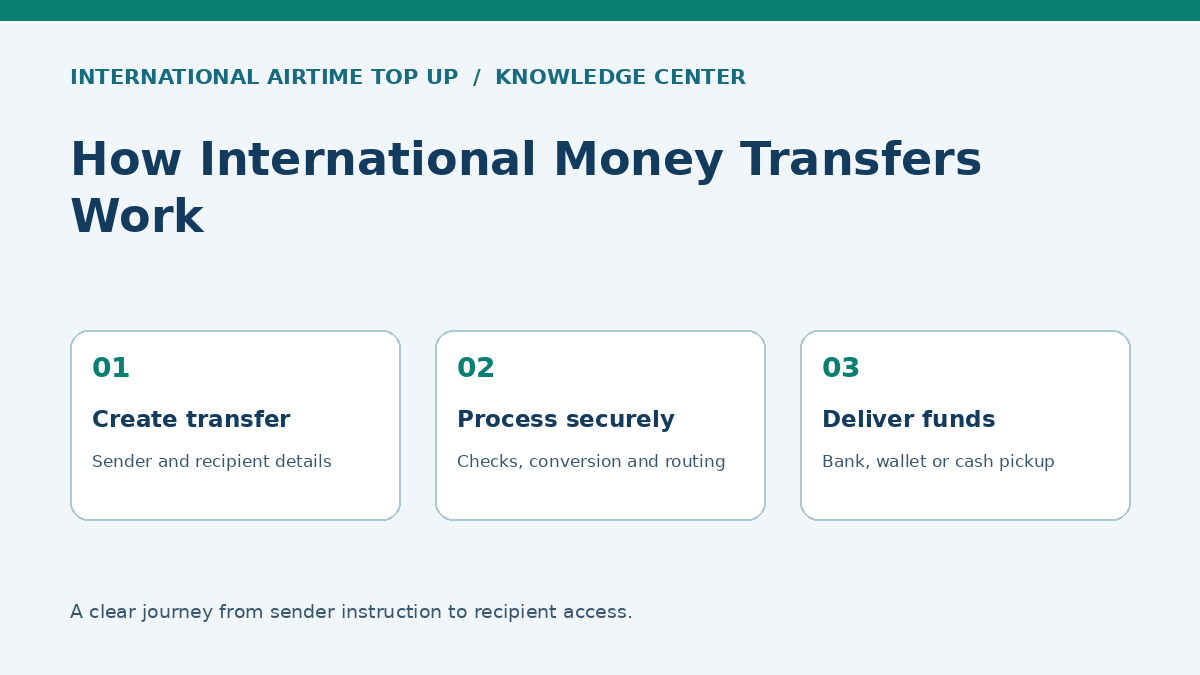
What is an international money transfer?
An international money transfer is a payment sent to a person or organisation in another country. The sender pays in an available funding currency, while the recipient normally receives money through a bank account, mobile wallet, cash-pickup location or another supported payout channel. The sending and receiving currencies may be the same, but a currency conversion is often required.
Several parties can participate in the journey. These may include the sender, the transfer provider, payment processors, banks, mobile-money operators, cash-pickup partners and the recipient. Not every transfer uses every participant. A transfer paid directly into a supported mobile wallet may follow a different route from a bank transfer that passes through one or more intermediary institutions.
The provider should show the transaction details before payment. These usually include the amount the sender will pay, applicable fees, the exchange rate, the amount expected to reach the recipient, the selected delivery method and an estimated delivery period. Availability, price and timing depend on the sending country, destination, currencies, payment method, payout method, transfer amount and required checks.
How international money transfers work: step by step
1. Confirm the destination and recipient
The sender selects the destination country and enters the amount to send or the amount the recipient should receive. The sender then chooses an available delivery method. Recipient information varies by method. A bank deposit may require the account holder's full name, bank name, account number and routing information. A mobile-wallet transfer commonly requires the recipient's registered name, mobile number and wallet provider. Cash pickup can require the recipient's legal name exactly as it appears on an acceptable identity document.
Accuracy matters. A spelling difference, transposed account digit, incorrect country code or inactive wallet can delay or prevent delivery. Before continuing, ask the recipient to provide the details directly and confirm them again.
2. Review the quote
The quote explains the financial terms of the proposed transfer. Look beyond a headline fee. Compare the complete amount you will pay with the amount the recipient is expected to receive. Check whether the rate is fixed for a stated period, whether additional recipient or intermediary charges may apply, and when the quote expires.
A quote can change before payment because foreign-exchange markets move and providers may update their rates. Once a provider confirms a rate for a specified transaction and period, the applicable terms should explain whether that rate is locked and what happens if payment arrives late.
3. Create or access an account
Many online transfer services require an account. The sender may need to provide a name, contact details, residential address and date of birth. Depending on the service, transaction and legal requirements, identity verification may be required before the first transfer or later as activity changes.
4. Choose a funding method
Available funding methods can include a bank account, debit card, credit card or another approved payment method. Each option can affect cost and timing. A card-funded transfer may be authorised quickly but can attract a provider fee or a charge from the card issuer. A bank-funded transaction may take longer to reach the provider. The sender should review both the transfer provider's disclosure and the funding institution's terms.
5. Complete payment and checks
After the sender authorises payment, the provider confirms whether funds have been received and whether the transfer can proceed. A payment authorisation is not always the same as completed funding. A card issuer or bank may decline, delay or review the payment. The transfer provider may also request information needed to verify identity, understand the transaction or meet regulatory obligations.
6. Convert and route the funds
If the currencies differ, the provider applies the exchange rate shown for the transaction. It then routes the payout through its own network or through a partner. Some providers maintain local payout arrangements, while bank transfers may use correspondent or intermediary relationships. The technical route is important to the provider, but the sender's practical focus should remain on the disclosed cost, recipient amount, delivery method and status.
7. Deliver and notify
The recipient receives the money through the selected channel when processing is complete. The provider may send a status notification to the sender and, where supported, to the recipient. The recipient should not rely only on a screenshot or message from another person; they should confirm the credit in their bank account or wallet, or follow the official cash-pickup procedure.
Common ways recipients receive money
| Delivery method | Typically suitable when | Important checks |
|---|---|---|
| Bank deposit | The recipient has an eligible bank account and prefers an account credit. | Account name, account number, bank identifiers, currency and processing time. |
| Mobile wallet | The recipient has an active, supported wallet registered to the correct mobile number. | Country code, number, wallet provider, registered name, wallet status and limits. |
| Cash pickup | The recipient needs cash and can reach an approved payout location. | Exact legal name, acceptable identification, reference information, location hours and collection period. |
| Other supported payout | A provider offers a corridor-specific delivery option. | Eligibility, charges, recipient requirements and applicable restrictions. |
No method is universally best. A bank deposit may be convenient for an account holder but unsuitable for someone without an eligible account. A mobile wallet can improve access, but the wallet must be active and supported for that corridor. Cash pickup can serve recipients who need physical cash, but identification and location access are important.
How fees and exchange rates affect the recipient amount
The visible transfer fee is only one part of the cost. When currencies differ, the exchange rate can also affect how much the recipient gets. The World Bank's Remittance Prices Worldwide programme explains that remittance prices can include a sender fee, an exchange-rate margin and, in some cases, a recipient fee.
Consider this simplified example. A sender wants to pay 200 units of one currency. Provider A charges a low visible fee but applies a less favourable exchange rate. Provider B charges a higher visible fee but applies a more favourable rate. Provider B could still deliver more money. The useful comparison is therefore:
Before paying, record the following:
- the transfer amount;
- the sender fee;
- any stated payment-method charge;
- the applied exchange rate;
- the recipient amount;
- any disclosed potential recipient or intermediary deduction; and
- the estimated delivery period.
Do not assume that “zero fee” means zero total cost. Equally, do not assume that the provider advertising the highest exchange rate will always deliver the best result; other charges and eligibility conditions can matter. Compare a live, like-for-like quote for the same corridor, amount, funding method and payout method.
Why transfer services verify identity and transactions
Money-transfer providers operate under legal and regulatory requirements that vary by jurisdiction. Customer due-diligence measures can involve identifying the customer, verifying identity and monitoring activity using a risk-based approach. The Financial Action Task Force provides international standards that countries adapt within their legal and financial systems.
A provider may request a government-issued identity document, proof of address, a photograph or other information. It may also ask about the source of funds, transfer purpose or relationship with the recipient. A request does not necessarily mean that the sender has done something wrong. It may be part of onboarding, a transaction limit, a periodic review or a risk-based check.
To reduce avoidable delays, use accurate information, upload clear and current documents, respond through official channels and ensure the payment method belongs to an authorised user. Never send identity documents to an address or messaging account that you have not independently confirmed as belonging to the provider.
How long does an international money transfer take?
There is no single delivery time for all transfers. Some eligible transactions can complete quickly, while others require additional processing. The estimate displayed for a specific transaction is more useful than a general promise.
Timing can be affected by:
- how quickly the sender's payment reaches the provider;
- weekends, holidays and banking cut-off times;
- incorrect or incomplete recipient information;
- identity, sanctions or transaction review;
- recipient-bank or mobile-wallet processing;
- intermediary institutions;
- technical outages or network interruptions;
- transaction and wallet limits; and
- whether the selected corridor and payout method remain available.
If a transfer is pending, first check the official status page or confirmation message. Confirm that payment was completed, review recipient details and respond to any genuine request for information. Avoid repeatedly starting duplicate transfers, because this can create extra authorisations or complicate support investigation.
Safer transfer practices
Send money only when you understand who will receive it and why. Fraudsters often create urgency, impersonate relatives or organisations, or instruct victims to move money to a supposedly “safe” account. The United States Federal Trade Commission warns that pressure to transfer money immediately is a common scam signal and that some completed transfers can be difficult to recover.
- Verify unusual requests through a separate, trusted contact method.
- Use the provider's official website or application.
- Create a unique password and enable additional authentication where available.
- Do not share one-time codes, passwords or full payment credentials.
- Review the recipient and amount before final confirmation.
- Keep receipts and transaction references.
- Contact the provider immediately if fraud or an incorrect recipient is suspected.
Four practical transfer scenarios
The following scenarios are realistic illustrations rather than claims about a particular customer's transaction. They show how the same basic process changes when the recipient, delivery method and reason for sending are different.
Scenario 1: Monthly family support paid into a bank account
Amara lives in the United Kingdom and plans to support her mother in Nigeria every month. Her mother has an active bank account and does not need to collect cash. Amara compares live quotes for the same sterling amount and Nigerian-naira bank deposit. She records the total sterling payment, the quoted naira amount, the estimated delivery period and whether the quote mentions possible third-party deductions.
The provider asks for her mother's legal name, bank name and account number. Amara obtains these details directly from her mother rather than copying an old message. Before paying, she reads the recipient name displayed for confirmation, where that feature is available. She saves the receipt and asks her mother to confirm the actual bank credit.
The lesson is that a repeat transfer should not become automatic in the sender's mind. Account status, exchange rates, prices and provider coverage can change. A fresh quote and a brief detail check remain useful even when the recipient is familiar.
Scenario 2: Urgent support delivered to a mobile wallet
Daniel is in Canada and his brother in Ghana needs money for urgent local transport. His brother actively uses a supported mobile-money wallet. Daniel confirms the wallet provider, the international-format mobile number and the exact registered account name. He also checks that the wallet is active and can receive the intended amount without exceeding a limit.
Daniel chooses wallet delivery because it fits the recipient's immediate access needs. However, he does not treat “mobile” as a guarantee of instant delivery. Payment authorisation, provider review, network availability and wallet processing can still affect timing. If the transaction remains pending, he checks the official status before attempting another payment.
The lesson is to choose the payout method around the recipient's real access—not only the sender's convenience. A wallet can be useful only when the recipient has the correct, active and supported account.
Scenario 3: Cash pickup for a recipient without an account
Sofia wants to send money to a relative who does not have a suitable bank account or mobile wallet. A cash-pickup service may solve the access problem, but it introduces different requirements. Sofia checks the approved collection locations, operating hours, required identification and the period during which the money will remain available.
She enters the recipient's full legal name exactly as it appears on the identity document. A nickname or missing surname could prevent collection. She shares only the information the recipient needs and reminds the recipient to use the official location and not pay an unknown person to “release” the transfer.
The lesson is that cash pickup is not merely a bank transfer without a bank account. Identity matching, physical access, location schedules and personal safety become central parts of the transfer plan.
Scenario 4: A bank payment involving an intermediary
Leila sends money to a supplier's foreign bank account. The quoted transfer fee appears reasonable, but the route may involve correspondent or intermediary institutions. Swift explains that cross-border bank payments can involve an originating bank, a beneficiary bank and one or more correspondent banks. Depending on the route and charging arrangement, an intermediary deduction may affect the credited amount.
Leila therefore asks a different question from a family-remittance sender: must the supplier receive an exact invoice amount? If so, she needs to understand whether fees are paid by the sender, shared, or deducted from the payment and whether the provider can guarantee the credited amount. She also verifies the supplier's identity and invoice independently to reduce business-email-compromise risk.
The lesson is that “send 1,000” and “recipient must receive exactly 1,000” are not always the same instruction. The sender should make the required outcome clear before selecting a route.
Understanding transfer statuses
Status wording differs between services, but most transfer journeys pass through recognisable stages. Understanding them helps the sender respond appropriately instead of creating a duplicate transaction.
| Possible status | What it commonly means | Useful response |
|---|---|---|
| Created or awaiting payment | The instruction exists, but the provider has not confirmed funding. | Check the payment instructions and whether the bank or card authorisation completed. |
| Payment received | The provider has received or confirmed the sender's funds. | Keep the receipt and allow the stated processing period. |
| Under review | Information, identity, payment or transaction checks are taking place. | Respond only through verified provider channels and supply clear, accurate information. |
| Processing or sent to partner | The provider or payout partner is routing the transfer. | Avoid duplicate transfers; monitor the official tracker. |
| Available for pickup | The cash-pickup partner indicates that collection can begin. | Confirm the official location, opening hours and identification requirements. |
| Completed | The payout channel reports delivery or collection. | Ask the recipient to confirm the actual credit or collection. |
| Failed, cancelled or reversed | The transfer did not complete or is being returned. | Read the stated reason and expected refund route; contact official support if unclear. |
A “completed” notification is important evidence, but it should not replace recipient confirmation. Bank posting descriptions can be unfamiliar, wallet messages can be delayed, and criminals can fabricate screenshots. The recipient should check the actual account or collect through the official process.
Common first-time mistakes—and why they matter
Comparing only the transfer fee
A low visible fee can be offset by a less favourable exchange rate. The World Bank treats the transfer fee and exchange-rate margin as components of remittance cost. Compare the final recipient amount for equivalent quotes. Our companion guide, International Money Transfer Fees Explained, provides a detailed comparison method.
Entering a local number without checking the international format
Mobile-wallet and airtime transactions often depend on a country code and correctly formatted number. Do not guess whether a leading zero should remain. Ask the recipient to confirm the full international-format number and the registered wallet provider.
Assuming a bank name is enough
International bank payments may require an account number, IBAN, routing number, branch code, SWIFT/BIC or other country-specific information. The necessary fields vary. Use the details requested for the specific destination and verify them with the recipient.
Using a nickname
Cash pickup and regulated accounts generally rely on the recipient's registered or legal identity. A familiar name may not match the identity document or account record, preventing payout.
Sending twice because the first transfer appears slow
A pending transaction is not necessarily a failed one. Starting again can create two successful transfers or two payment authorisations. Check status and contact support before repeating the instruction.
Trusting an unsolicited support contact
A criminal may see a public complaint or social-media post and impersonate customer support. Navigate independently to the provider's official website or application. Do not disclose a password, PIN or one-time code.
Receipts, disclosures and error resolution
Consumer protections depend on where the transfer is initiated, the provider and the type of payment. For example, the US Consumer Financial Protection Bureau's Remittance Transfer Rule requires covered providers to disclose specified information such as the exchange rate, certain fees and the amount expected to be received. It also contains cancellation and error-resolution provisions. These US rules should not be assumed to apply everywhere, but they illustrate why a sender should retain the pre-payment disclosure and final receipt.
Your evidence file should contain the transaction reference, provider name, date and time, sender payment, exchange rate, recipient amount, recipient details as entered, delivery estimate and relevant communication. If a problem occurs, describe the expected outcome and actual outcome precisely. “My transfer is wrong” is less useful than “the receipt states 500 units should be available by 16 August, but the recipient account shows no credit as of 18 August.”
If you suspect fraud, contact the provider and funding institution immediately. Speed matters because some transfers become difficult to reverse after payout. Also report the incident to the appropriate national fraud-reporting or law-enforcement channel.
How to choose the right route
Begin with the recipient, not the technology. Ask what the recipient can safely and conveniently access. Then compare eligible routes.
- Recipient access: Does the person have an eligible bank account or active wallet? Can they reach a cash location?
- Required outcome: Is an approximate family-support amount acceptable, or must an invoice be credited in full?
- Urgency: What is the actual deadline, and what does the provider estimate for this exact route?
- Total delivered value: How much will the sender pay and the recipient receive?
- Verification readiness: Are names, documents and the transfer purpose accurate and available?
- Support and recourse: Can the sender track the payment and reach a verified support channel?
For example, a rural recipient without a bank account may prefer a well-located cash outlet or supported wallet even if a bank deposit looks attractive on price. Conversely, a recipient paying rent electronically may prefer a direct account credit rather than travelling to collect cash. “Best” depends on the complete use case.
The five-minute conversation to have with the recipient
Many avoidable transfer problems begin because the sender makes assumptions on the recipient's behalf. A brief conversation before payment can establish the information that a price-comparison website or transaction form cannot know.
“How do you want to use the money?”
If the recipient intends to pay an online bill, an account or wallet credit may be more practical than cash. If the recipient needs physical cash immediately, ask whether a wallet cash-out point or bank branch is accessible and what local withdrawal charge could apply. For a school or medical payment, consider whether the institution should be paid directly, where supported, instead of sending through another person.
“Which account or wallet is active today?”
People change banks, mobile numbers and wallet providers. A transfer route used six months ago may no longer be appropriate. Ask the recipient to confirm the details from the current account record rather than from memory. If mobile-number portability exists, the number prefix may not reliably identify the current network, so direct confirmation is stronger than guessing from the prefix.
“Does your registered name match your identification?”
A recipient may use a shortened name socially while the bank, wallet or identity document contains several names. Ask for the name needed by the selected payout method. Do not “correct” unfamiliar spelling without confirming it.
“When do you actually need access?”
“Urgent” can mean within an hour, by the end of the day or before a bill is due next week. Clarifying the true deadline helps the sender weigh delivery estimates against price. Paying more for a faster route has little value if the recipient cannot reach the collection point until the following day. Conversely, selecting a slow bank route to save a small amount may be unsuitable during a genuine emergency.
“What will you do if the notification does not arrive?”
Agree that the recipient will check the actual account or wallet and contact the sender through a known channel. This reduces confusion if SMS is delayed and makes it harder for an impostor to redirect the transaction. Neither person should disclose a PIN, password or one-time security code to complete receipt.
This conversation also protects dignity. The sender should avoid treating the recipient as a passive endpoint. The recipient often understands local access, safety, withdrawal conditions and operating hours better than the sender. A sound transfer decision combines the sender's quote information with the recipient's local knowledge.
Finally, agree how the two of you will recognise completion. For a bank or wallet transfer, the recipient should confirm the posted credit rather than rely on the sender's payment screen. For cash pickup, confirmation means successful collection from the authorised location. If the result differs from the receipt, write down the discrepancy and contact official support promptly. A shared understanding of the expected amount, channel and timing makes troubleshooting faster and prevents a normal processing delay from becoming unnecessary panic.
First-time sender checklist
- Confirm that the provider supports the sending country, destination and required delivery method.
- Verify the recipient's legal name and delivery details directly with the recipient.
- Compare the total sender payment and final recipient amount, not only the advertised fee.
- Read the estimated delivery period and the conditions that may affect it.
- Prepare accurate identity and transaction information.
- Confirm the provider's official contact and support channels.
- Review every detail before authorising payment.
- Save the receipt and tracking reference.
- Ask the recipient to confirm actual receipt through the official payout channel.
Frequently asked questions
Does the recipient need a bank account?
Not always. Depending on the supported corridor, the recipient may be able to receive money through a mobile wallet or cash-pickup location. Eligibility and requirements vary.
Is a transfer fee the complete cost?
Not necessarily. Currency conversion, payment-method charges, intermediary deductions or recipient fees may also affect the total cost or recipient amount. Review the complete quote and disclosures.
Can an international transfer be cancelled?
Cancellation depends on the provider, payment status, payout method and applicable law. Contact the provider immediately. Once money has been paid out or credited, recovery may be difficult or impossible.
Why is identification required?
Providers may need to identify and verify customers and review transactions to meet legal, regulatory and risk-management obligations. Requirements differ by jurisdiction and transaction.
What should I do if the recipient has not received the money?
Check the official transfer status, confirm the recipient details and ensure the recipient has checked the correct bank account, wallet or pickup process. If the estimate has passed, contact official support with the transaction reference and requested evidence.
Ready to review your transfer options?
Check the currently supported destinations, payout methods, quote and recipient requirements before authorising a transaction.
Explore money transfer optionsAuthoritative sources
- World Bank — About Remittance Prices Worldwide
- US Consumer Financial Protection Bureau — Remittance Transfer Rule
- Financial Action Task Force — The FATF Recommendations
- US Federal Trade Commission — What to Know Before You Wire Money
- Swift — Interbank Payments and Correspondent Banking
Information notice: This guide is general educational information, not financial, legal or regulatory advice. Service availability, requirements, prices, exchange rates and delivery periods can change and vary by corridor and transaction. Review the live transaction quote and applicable terms before proceeding.