
What is the real cost of an international money transfer?
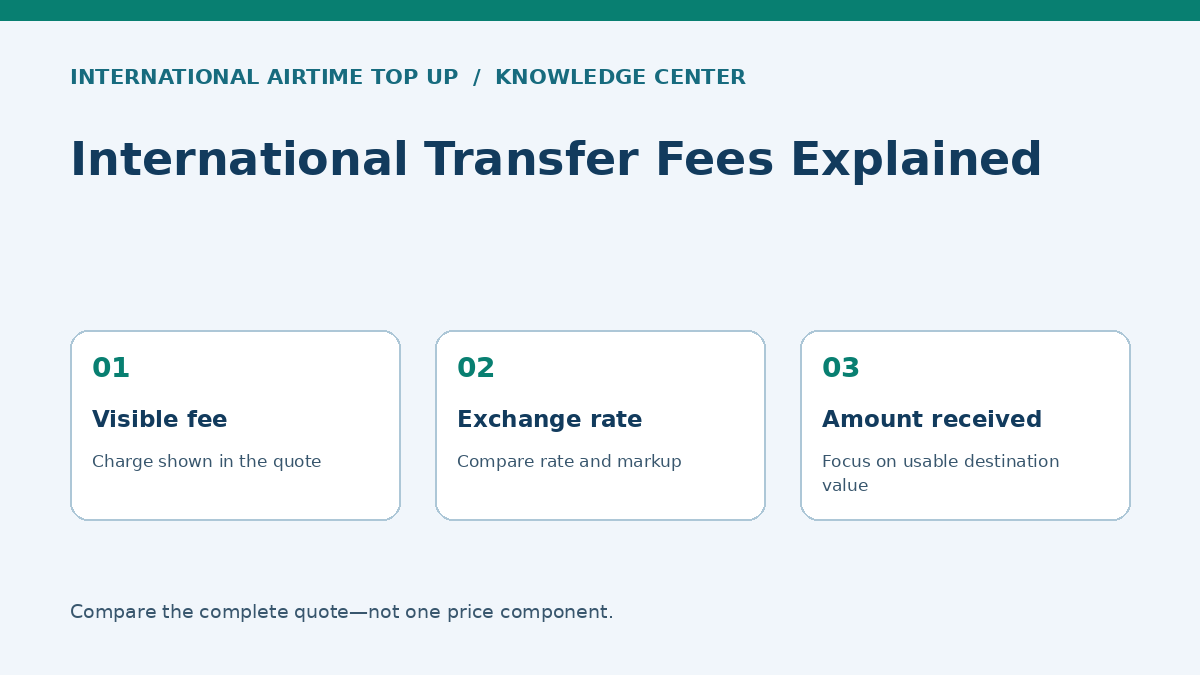
The real cost is not necessarily the number printed beside “fee.” It is the combined effect of every charge and conversion that separates the sender's money from the value available to the recipient. A useful starting equation is:
Not every component applies to every transfer, and not every possible third-party deduction can always be known in advance. The objective is therefore not to force all transfers into one formula but to identify which components apply to the exact corridor, amount, funding method and payout method being considered.
The World Bank's Remittance Prices Worldwide methodology treats the sender fee and exchange-rate margin as core parts of remittance cost. It also notes that a recipient fee can sometimes apply. This is why a provider advertising a small fixed fee can still be more expensive than another provider once the recipient amount is compared.
Seven possible components of transfer cost
| Cost component | How it may appear | Question to ask |
|---|---|---|
| Transfer fee | A fixed amount, percentage, tiered charge or fee included in the sender total. | What is the exact fee for this amount, route and delivery method? |
| Exchange-rate margin | The retail exchange rate is less favourable than a reference or mid-market rate. | How much foreign currency will the quoted rate produce? |
| Funding-method charge | A card, bank or provider charge linked to how the sender pays. | Will the provider, bank or card issuer add a separate charge? |
| Intermediary-bank deduction | A correspondent bank deducts an amount while routing a bank payment. | Can an intermediary deduct from the transfer, and is the amount known? |
| Recipient-institution charge | The recipient's bank, wallet or payout agent charges for crediting, receiving or withdrawing. | Will the recipient receive the stated amount before or after local charges? |
| Taxes or government charges | A tax, levy or mandatory charge applies in the sending or receiving jurisdiction. | Which taxes are included in the quote and which may be collected later? |
| Incidental access cost | Travel to a cash location, mobile-data use or time spent collecting funds. | Is the cheapest quoted route still practical for the recipient? |
The last component is not normally part of a provider's transfer price, but it matters to the household. A payout that is marginally cheaper on screen may be worse overall if the recipient must travel far, pay transport costs and lose working time to collect it.
How an exchange-rate margin changes the amount received
Currency markets have reference rates, while providers offer retail rates for actual transactions. The difference may reflect costs, risk, service design and revenue. For a consumer, the important consequence is simple: a less favourable rate converts the same sending amount into less recipient currency.
Suppose a reference rate is 1 sending-currency unit = 100 recipient-currency units. A provider offers 97.50. Ignoring every other charge, 1,000 sending units would convert as follows:
| Calculation | Result |
|---|---|
| At reference rate: 1,000 × 100 | 100,000 recipient units |
| At provider rate: 1,000 × 97.50 | 97,500 recipient units |
| Difference | 2,500 recipient units |
This is an illustrative calculation, not a live market quote. Its purpose is to show that a price can exist inside the conversion even when the invoice says “transfer fee: 0.”
Exchange rates can move between quotations. Compare providers as close together in time as reasonably possible, using the same transfer amount and delivery setup. A quote from Monday morning should not be treated as directly comparable with a quote obtained after a significant market move on Tuesday.
Why “zero transfer fee” may not mean zero cost
A zero-fee promotion can be genuine: the provider may waive its usual fixed fee. But it does not automatically mean that the provider performs currency conversion at the reference rate or that no other charge applies.
The UK Financial Conduct Authority has published examples of good and poor international-payment pricing practice. In its poor-practice illustration, a firm shows a £100 payment, a firm exchange rate and a £0 fixed fee but does not clearly tell the customer that its rate differs from the reference rate. The FCA explains that emphasising no fixed fee without making the exchange-rate difference clear may create the misleading impression that no cost applies.
The lesson is not that every zero-fee transfer is poor value. The lesson is that “fee” and “total cost” are different concepts. Ask:
- What total amount will leave my account?
- What exact amount is expected to reach the recipient?
- Which exchange rate is used?
- How does that rate compare with a credible reference observed at approximately the same time?
- Can another institution deduct money?
Worked scenarios: why headline fees can mislead
These calculations are transparent teaching examples. Providers A, B and C are fictional; the arithmetic demonstrates the comparison method and must not be treated as current pricing.
Scenario 1: Lower fee, lower recipient amount
A sender wants to transfer 500 currency units. Two providers quote at nearly the same time for the same bank-deposit route.
| Provider A | Provider B | |
|---|---|---|
| Transfer fee | 0 | 5 |
| Sender pays | 500 | 505 |
| Quoted recipient amount | 47,500 | 49,000 |
| Known later deductions | None disclosed | None disclosed |
Provider A wins if the sender looks only at the fee. Provider B delivers 1,500 more recipient-currency units for five additional sending units. The appropriate choice depends on the sender's objective, but Provider B provides the stronger delivered value in this simplified example.
Scenario 2: Same fee, different payment method
A provider quotes a transfer fee of 4 whether the sender pays from a bank account or by card. The bank-funded route takes longer but has no additional provider funding charge. The card-funded route has an extra 2% charge. On a 400-unit transfer, that additional percentage equals 8 units, so the card-funded sender pays 412 rather than 404.
The faster funding route may still be appropriate for an urgent need, but it is not the same price. The sender should compare urgency and total cost rather than assuming the displayed transfer fee settles the question.
Scenario 3: Recipient must receive an exact invoice amount
A small business must pay a supplier exactly 1,000 units. Its bank quotes a 20-unit sender fee, but the payment route may allow an intermediary to deduct 15 from the transfer. Sending 1,000 could therefore leave the supplier with 985, creating an unpaid invoice balance even though the sender followed the visible instruction.
The CFPB's official interpretations include a documented regulatory example in which a sender instructs a provider to send US$100, pays a US$10 transfer fee and a correspondent deducts US$15. The official example is used in the context of error-resolution rules and shows why intermediary deductions and accurate instructions matter.
For an exact commercial payment, the sender should ask which charging arrangement applies and whether the recipient amount can be guaranteed. This need is different from a family transfer where a small variation may be manageable.
Scenario 4: The practical cost of cash collection
Provider C's cash-pickup quote delivers slightly more money than a mobile-wallet quote. However, the recipient must travel to another town, pay for transport and wait for the location to open. If the recipient has a safe, active wallet and can use the balance locally, the wallet route may create greater household value despite the slightly lower quoted payout.
This does not mean wallet delivery is always better. It means comparison should include access, safety and withdrawal needs. If the recipient must immediately cash out and the wallet charges for withdrawal, include that local cost as well.
Intermediary banks and recipient deductions
Some international bank transfers travel through correspondent banks because the sending and receiving institutions do not settle directly with each other. Swift describes correspondent banking as a central mechanism for cross-border payments. Each route can have different participants and charging arrangements.
Common bank-payment fee instructions are sometimes described as:
- Sender pays: the sender is intended to cover transfer charges;
- Shared: the sender pays sending-side charges while other charges may be deducted from the transfer; or
- Recipient pays: charges may be deducted before or when the recipient is credited.
Terminology and outcomes vary. Even when a sender selects an option intended to cover charges, the provider should explain what it can and cannot guarantee. For a time-sensitive invoice, obtain clarity before payment rather than trying to reconstruct deductions afterwards.
Recipient institutions may also charge for incoming payments or cash withdrawal. A mobile-wallet credit, for example, can arrive in full but generate a later fee when the recipient converts the wallet balance to cash. That withdrawal fee is distinct from the international transfer price, yet it matters when comparing how much usable cash the recipient finally holds.
Why transfer size changes the percentage cost
A fixed fee has a larger percentage effect on a small transfer. A fee of 5 equals 5% of a 100-unit transfer but only 0.5% of a 1,000-unit transfer. A percentage-based exchange-rate margin, by contrast, grows with the amount converted.
| Transfer amount | Fixed fee | Fee as percentage of amount |
|---|---|---|
| 100 | 5 | 5% |
| 500 | 5 | 1% |
| 1,000 | 5 | 0.5% |
This arithmetic does not imply that people should send more than they need or can safely afford. Combining transfers can also delay necessary household support, change verification requirements or exceed a provider or recipient limit. It simply explains why the cost percentage can differ by amount.
Providers may also use price tiers. The exchange rate, fixed fee or promotion available at one amount may change when the amount changes. Always quote the actual intended transaction rather than extrapolating from an advertisement.
What international regulators and evidence say about comparison
The World Bank maintains corridor-level Remittance Prices Worldwide data because remittance cost is multi-dimensional and varies across markets, providers, instruments and payout methods. Its data distinguish fees from exchange-rate margins, reinforcing the need to evaluate both.
The US CFPB requires covered remittance providers to disclose specified information. Its rules state that the disclosed amount received must reflect the exchange rate and applicable covered fees and taxes. Coverage and rights are jurisdiction-specific, but the disclosure structure offers a useful comparison checklist for senders everywhere.
The Australian Competition and Consumer Commission reported through its foreign-currency conversion work that shopping around can save money and that major banks were often more expensive than other suppliers for common currencies in its assessed samples. That finding should not be converted into a permanent claim that a particular provider type is always cheaper. The practical message is to compare live quotes rather than defaulting to loyalty or habit.
The FCA's research on presenting foreign-exchange quotes likewise focuses on helping consumers understand total cost. Across these sources, the consistent principle is transparency: compare delivered value using information presented in a form that allows a like-for-like decision.
A seven-step method for comparing transfer quotes
- Fix the use case. Use the same sending country, destination, amount and recipient need.
- Fix the payout method. Do not compare one provider's cash pickup with another provider's bank deposit unless you are deliberately evaluating those service differences.
- Fix the funding method. Compare bank-funded with bank-funded or card-funded with card-funded.
- Quote at nearly the same time. Currency markets move, so save the quote time.
- Record sender total and recipient amount. These are more informative together than the fee alone.
- Record possible later deductions. Note intermediary, recipient, wallet cash-out or local taxes where relevant.
- Compare service conditions. Include delivery estimate, recipient access, tracking, cancellation terms and verified support.
Copyable quote-comparison worksheet
- Provider and quote time:
- Sending and receiving countries:
- Sender amount before fees:
- Total sender payment:
- Funding method:
- Delivery method:
- Exchange rate:
- Expected recipient amount:
- Potential third-party deductions:
- Estimated availability:
- Cancellation/error information:
Costs that depend on the transfer's purpose
Recurring household support
A sender making monthly transfers should compare more than a first-transfer promotion. A discount may make the first payment attractive while the normal rate, standard fee or eligibility conditions govern every later transfer. Record the ordinary quote before building a household budget around a promotional price.
Frequency also changes the effect of fixed fees. Four weekly transfers can attract a fixed charge four times, whereas one monthly transfer may attract it once. Combining transfers is not automatically better: the recipient may need money sooner, a larger transfer may trigger different limits, and holding funds back can create hardship. The relevant question is whether the schedule meets the recipient's needs at a sustainable total cost.
Education, medical and invoice payments
When a school, hospital, landlord or supplier must receive an exact amount, possible deductions deserve greater attention. Ask whether the institution accepts the selected route, what reference must accompany the payment and who carries any shortfall. A low-cost route that leaves an invoice underpaid can produce penalties, reconciliation delays or an additional transfer fee.
Emergency transfers
During an emergency, a sender may rationally accept a higher cost for a route that is genuinely available sooner. Still compare the live recipient amount and verify the request independently. Criminals exploit urgency, and a faster payment can also become irreversible sooner. The appropriate trade-off is informed speed—not speed without verification.
Large legitimate transfers
A price that appears small in percentage terms can represent a substantial absolute amount when the transfer is large. A one-percentage-point conversion difference equals 10 units on 1,000 but 1,000 units on 100,000. Larger payments can also require additional verification, source-of-funds information or specialist banking instructions. Do not split a transfer merely to avoid legitimate checks or reporting requirements; seek provider guidance and applicable professional advice.
Mobile-wallet receipt followed by cash-out
The international transfer may credit the advertised wallet amount in full, yet the recipient may pay a local withdrawal fee to obtain cash. If the recipient can spend digitally, that fee may be avoidable. If local merchants require cash, include the expected withdrawal cost when comparing wallet delivery with direct cash pickup.
These cases show why “cheapest provider” is often the wrong question. A more useful question is: which eligible route provides the required recipient outcome, within the needed time, at the lowest complete and adequately disclosed cost?
Pricing and marketing red flags
- A zero-fee claim with no clear recipient amount or exchange-rate explanation.
- A comparison against another provider that uses a different time, amount or delivery method.
- A rate described as “best” without defining the reference, time and conditions.
- An urgent request to pay outside the provider's official process.
- A quote that changes at confirmation without explaining which input changed.
- No accessible information about possible intermediary or recipient charges.
- A promotion whose eligibility, expiry date or first-transfer limitation is difficult to find.
A red flag is a reason to investigate, not automatic proof of misconduct. Read the complete pre-payment disclosure and terms. If material information remains unclear, pause and ask the provider through an independently verified support channel.
Frequently asked questions
What is the real cost of an international money transfer?
The real cost is the difference between the sender's total payment and the value ultimately available to the recipient. It can include a transfer fee, exchange-rate margin, funding charge, intermediary deduction, recipient fee and applicable taxes.
Does zero transfer fee mean the transfer is free?
No. A provider may charge no separate transfer fee but earn revenue through the exchange rate or another charge. Compare the recipient amount and total sender payment rather than relying on a zero-fee label.
What is an exchange-rate margin?
It is the difference between a reference exchange rate and the retail rate applied to the transfer. The difference can reduce the amount of foreign currency the recipient receives.
Can an intermediary bank deduct money?
In some bank-transfer routes, an intermediary or recipient institution may deduct a charge. Whether the amount is known in advance depends on the route, provider and applicable disclosure rules.
How can I compare two providers fairly?
Request live quotes at nearly the same time for the same amount, currencies, funding method and payout method. Compare total amount paid, amount received, delivery estimate and possible third-party deductions.
Compare the complete transfer—not only the fee
Review the live exchange rate, sender total, expected recipient amount, delivery method and relevant deductions before confirming a transfer.
Explore money transfer optionsAuthoritative sources
- World Bank — About Remittance Prices Worldwide
- World Bank — Remittance Prices Worldwide reports and resources
- US Consumer Financial Protection Bureau — Remittance-transfer disclosures
- US Consumer Financial Protection Bureau — Official error-resolution interpretations
- UK Financial Conduct Authority — International-payment pricing transparency
- Australian Competition and Consumer Commission — Foreign currency and money exchange
- Swift — Interbank payments and correspondent banking
Information notice: This guide provides general educational information, not financial, legal, tax or regulatory advice. Prices, exchange rates, taxes, availability and delivery conditions vary by provider, corridor, amount, payment method and time. Worked calculations are illustrative and are not live quotations. Review the provider's current disclosure and applicable terms before proceeding.