
How to choose a money-transfer route to Ghana
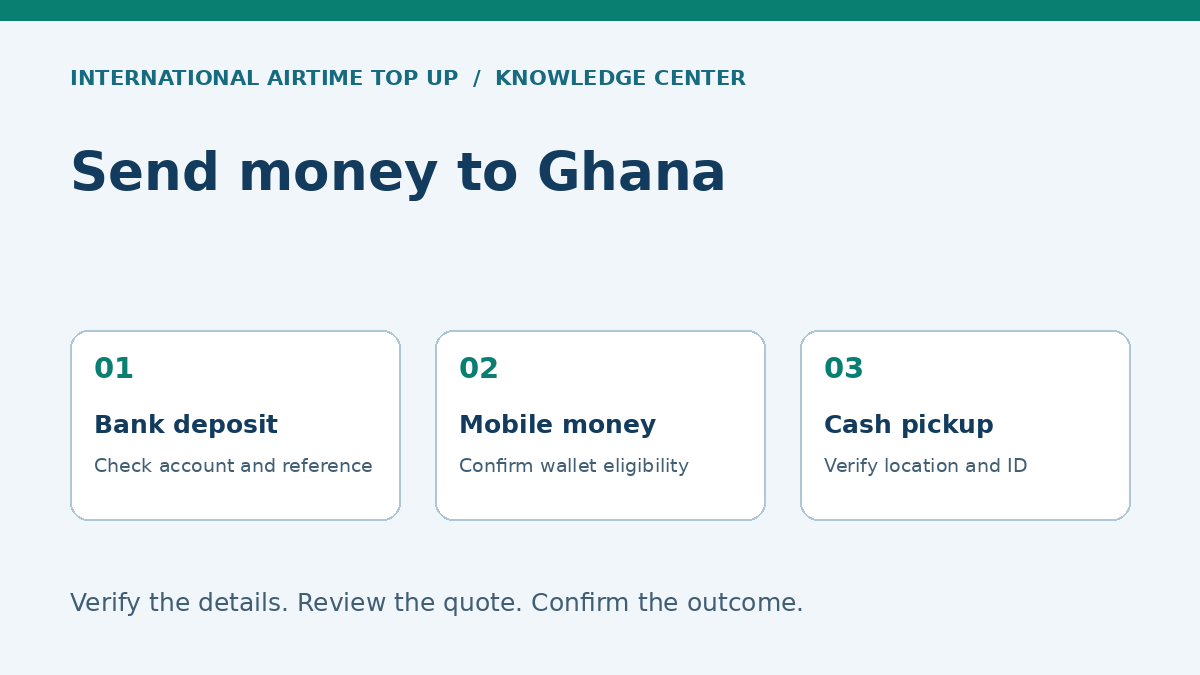
Sending money to Ghana starts with two decisions: how the recipient will use the money and which eligible route can deliver it. A direct bank credit may suit an invoice or household account, a mobile wallet may suit everyday digital spending, and cash pickup may suit a recipient who needs physical currency. The best choice is the one that combines verified eligibility, real access, a transparent price and suitable timing.
Do not begin with the advertised fee alone. Ask the recipient whether the account or wallet is active, whether an approved cash location is accessible and whether the payment requires a specific reference. Then compare live quotes from supported sending-country routes. Availability can differ even between customers using the same brand from different countries.
This guide explains inbound consumer-transfer decisions and common practical problems. It is not confirmation that every provider offers every Ghana route. Figures and scenarios are illustrative. A focused companion guide explains sending to an MTN MoMo account in Ghana.
Understand the regulated service arrangement
Bank of Ghana publishes guidance for inward-remittance services involving payment service providers. Its framework is a reminder to verify the actual regulated entities and payout arrangement, rather than relying solely on a commercial brand or an app's popularity. Ask which company accepts the sender's money, which Ghana institution delivers it and how to make a complaint. Source: Bank of Ghana inward-remittance guidance.
Registration as an ordinary company is not interchangeable with authorisation to provide a particular payment service. A provider may work through partners, and a route can change when those arrangements change. Confirm the current service rather than assuming that a successful transfer from years ago proves continuing availability.
For a commercial invoice, property payment or other specialised transaction, ask whether the consumer route is suitable. Do not describe a business payment as family support merely because a personal form is easier to complete. The required records, recipient type and bank arrangements may be different.
Bank deposit: convenient when the account fits the purpose
A Ghana bank deposit can be practical when the recipient uses an active account and needs a clear transaction record. Obtain the full account name, bank and account details from a trusted source. Follow any additional branch, routing, address or reference requirements shown by the selected provider.
Do not assume every Ghana bank uses the same account-number format. Copy the exact number supplied by the recipient or institution and investigate any validation mismatch. Where an account-name check is available, confirm that the result makes sense before authorising the payment. A valid number can still belong to the wrong person.
For school fees, supplier invoices or rent, verify who must receive the funds and which reference identifies the obligation. Sending money to a relative's account to forward later adds another step and can complicate reconciliation. Direct institutional payment may be more suitable if the provider and institution support it.
Mobile money: verify the wallet, not just the phone number
Mobile-money delivery can place funds directly in an eligible registered wallet. The recipient may then use supported digital payments or withdraw through an authorised agent. A phone number alone does not establish that the wallet is active, correctly registered, within its limits or eligible for the specific international route.
Confirm the wallet brand, current number, registered name and personal or business account type. Some international services distinguish personal wallets from merchant or business wallets. For example, WorldRemit's Ghana guidance says its supported wallets must be active and fully registered and flags restrictions on MTN business-wallet receipt. Those are route-specific conditions to verify, not a universal limit for every provider. Source: WorldRemit's Ghana mobile-money instructions.
If the recipient will immediately withdraw, compare the cash-out cost and local agent access. A wallet credit can be successful while physical cash is unavailable at the nearest agent. If the recipient can pay digitally, withdrawal may not be necessary. The appropriate comparison is usable value, not only the balance credited.
Cash pickup: confirm the exact location and identification
Cash pickup can be useful when the recipient needs physical money and can reach an authorised partner. Confirm that the live route supports Ghana and the intended amount, then check the actual collection location, hours, accepted identification and payout currency.
Enter the recipient's name as required by the identification rules, not merely a nickname used in family messages. Ask about spelling differences or compound names before payment. Share the collection reference privately after confirmation and tell the recipient to use the authorised location, not an unofficial person offering to collect on their behalf.
Travel and safety matter. A location listed in the capital may be impractical for someone far away. A branch may be closed when funds become ready. If collection requires a long journey, the recipient should verify the current status and location before travelling with identity documents.
Compare the three methods side by side
| Recipient situation | Method worth checking | Decisive question |
|---|---|---|
| Uses an active bank account | Bank deposit. | Can the account receive the currency and transaction type? |
| Spends digitally through an active wallet | Mobile money. | Is that wallet eligible for this international route? |
| Needs physical cash without suitable digital access | Cash pickup. | Is an authorised location genuinely accessible with accepted ID? |
| Must settle an exact invoice | Supported direct institutional payment. | Will the required amount and reference arrive correctly? |
| Lives far from formal branches | Depends on local wallet, agent and bank access. | Which route is usable after credit, including withdrawal needs? |
This is a decision framework rather than a provider ranking. The general payout comparison covers the trade-offs in more detail. Ask the recipient about real local access rather than choosing on their behalf based on assumptions about Ghana as a whole.
Ghana cedi quotes and complete transfer costs
GHS is the currency code for the Ghana cedi. Confirm the payout currency and amount in the live quote rather than assuming that the recipient receives the sender's payment currency. Where a different currency or account type is requested, obtain the correct instructions from the bank or provider.
Compare total sender payment, rate, recipient amount and known later charges for identical funding and payout methods. A no-fee promotion may still use a different conversion rate. A wallet transfer may be credited in full but incur a later withdrawal cost. A bank route may have separate recipient or intermediary conditions.
Suppose two fictional offers both cost the sender 100 units in total. One delivers GHS1,200 before a known GHS10 access cost, leaving GHS1,190 usable in that scenario. Another delivers GHS1,195 with no additional access cost for the recipient's intended use. The second outcome is slightly better despite a lower displayed credit. These numbers are not live prices; they show why the final use matters.
The complete sending workflow
- Verify the recipient and the purpose through a trusted channel.
- Confirm Ghana is supported from the sender's country for the intended amount.
- Select the delivery method the recipient can actually use.
- Collect the exact bank, wallet or cash-pickup information.
- Review the current quote, payout currency, total cost and arrival estimate.
- Complete legitimate identity and funding checks without misrepresenting details.
- Recheck the beneficiary and save the confirmation and reference.
- Track delivery and confirm actual receipt through the recipient's official account or collection process.
Where a form offers saved recipients, review the current details before reuse. A recipient may have changed bank accounts, ported a number or moved to a different town. Saved data reduce typing but do not establish that an old instruction remains correct.
Phone numbers, portability and wallet names
Ghana uses country calling code +233. Follow the provider's example for entering the national number and removing any domestic trunk prefix. If the interface already supplies the country code, do not duplicate it. Read back the complete destination before paying.
Ghana's National Communications Authority explains that mobile number portability allows subscribers to change networks while retaining their number. Consequently, a familiar prefix should not be treated as decisive evidence of the current operator or wallet. Confirm the actual wallet with the recipient and investigate contradictory validation information. Source: NCA frequently asked questions on portability.
The wallet's registered name may include elements absent from a casual contact label. Use the legitimate account details and ask the provider how to handle a spelling or name-format difference. Never substitute another person's name simply to pass validation. The recipient should correct genuine registration problems with their wallet provider.
Timing, limits and account readiness
Funding, verification, partner availability, bank cut-offs and recipient restrictions can all influence timing. A previous rapid transfer is not a promise for the next one. Confirm whether the delivery estimate begins at order creation or after the provider receives funds and completes checks.
Limits may exist at the sender, provider, individual transaction and recipient-wallet levels. An incoming transfer can fail if it would exceed a balance ceiling even when its amount is below a per-transfer limit. Ask about the recipient's available capacity before a large payment rather than publishing one universal Ghana limit.
For deadline-sensitive support, allow a correction window and agree a legitimate backup plan. Do not create duplicate transfers while the first is pending. If a route is unavailable, compare another supported method with the recipient rather than trying to bypass the restriction.
Four practical Ghana scenarios
Monthly support in a bank account
A recipient pays bills from a bank account. The sender verifies the unchanged details and compares normal recurring prices rather than a one-time promotional rate. Both keep a monthly reference so they can distinguish the transfer from other credits and identify any missing payment quickly.
A wallet recipient who needs cash
A recipient normally uses mobile money but needs physical cash for a particular expense. Before sending, they check legitimate withdrawal access and expected fees. The sender compares wallet delivery with available cash pickup on the basis of the final usable amount and travel time.
School payment with an exact amount
A school requires a specified cedi sum and student reference. The sender asks whether the chosen route can deliver that amount without an unplanned deduction and include the reference. A slightly cheaper route that cannot carry the required information may create administrative delay after the money arrives.
An account rejected during validation
The number is correct for phone calls, but the chosen wallet destination is not eligible. The sender asks the recipient to verify registration, wallet type and current operator. They do not guess another brand or send to a third party suggested by an unknown support account.
Handling delays, disputes and suspicious requests
If a transfer is late, compare the official status with the original estimate and confirm the recipient details. Ask the recipient to check the account or wallet directly rather than relying only on an alert. Contact the sender-side provider with the reference and ask whether the destination partner has acknowledged, rejected or credited it.
If the amount differs, separate conversion, disclosed charges and later withdrawal from a genuine delivery discrepancy. Save the quote and actual credit evidence. A coherent record makes it easier to explain what was promised and what happened.
Independently verify unexpected changed details, emergencies and requests to return money to another number. Never disclose a PIN or one-time code to receive a remittance. Suspected fraud should be reported promptly to the provider and funding institution. The security checklist sets out the immediate actions.
Build the budget around the recipient's usable amount
A household budget should distinguish the amount credited from the amount available for its intended purpose. If the recipient spends digitally, the relevant costs may differ from those of someone who withdraws immediately. If cash pickup requires travel, transport and time can outweigh a small improvement in the quoted payout.
Ask the recipient to describe the next step after receipt. Will they pay rent from the account, withdraw at an agent, travel to a branch or forward money to an institution? The answer reveals whether the selected route reduces or adds friction. A transfer method should not be chosen solely because the sender finds its app convenient.
For recurring support, compare standard pricing rather than only introductory incentives. A first-transfer offer can be useful without representing the price of the next twelve payments. Keep a representative record of sender total, recipient amount, access costs and arrival time, while recognising that future prices and processing can change.
Rural access and assisted collection
Local conditions vary within Ghana. Ask about the recipient's actual nearby bank, authorised agent or collection location, rather than assuming access from a national coverage statement. A recipient with a wallet may have good digital spending options but limited cash availability nearby; another may prefer bank access at a regular market-day visit.
If the recipient needs assistance, check the provider's rules before arranging collection by someone else. Cash-pickup identification normally concerns the named beneficiary, and a helper should not impersonate that person. Similarly, someone helping operate a phone should not retain the wallet PIN or take control of the account.
For a recipient with accessibility or language needs, discuss the process in advance and choose a legitimate channel they understand. Confirm the final amount together without sharing security credentials. Convenience should make receipt easier without moving control of the money to an unverified intermediary.
When a transfer is returned rather than delivered
A rejected bank or wallet payment may need to be returned through the provider before the sender is refunded. Ask why it was rejected, whether the funds have returned and whether a corrected transfer requires a new quote. The original exchange rate or promotion may not automatically remain available.
Do not assume a pending refund means the recipient received money. Equally, do not create a replacement until you understand whether the original can still complete. Record each transaction separately if a new order is legitimately required, so the recipient can identify duplicate or delayed credits.
Where the provider's explanation is unsatisfactory, use its formal complaint process and retain the case reference. The appropriate escalation route depends on the entity providing the service and the relevant jurisdiction; an international transfer can involve more than one institution. Start with the provider responsible for your order rather than sending sensitive documents to an unverified third-party contact.
Frequently asked questions
What are the main ways to send money to Ghana?
Depending on the current provider and route, options can include bank deposit, eligible mobile-wallet delivery and cash pickup. Confirm availability before paying.
Does every Ghana mobile number have an eligible wallet?
No. Confirm the wallet brand, active registration, account type and eligibility for the specific international route.
What currency will the recipient receive?
Check the live quote. GHS denotes Ghana cedi, but the supported payout currency and account type depend on the service.
Are mobile-wallet limits the same across providers?
No. Sender-side, provider, transaction and recipient-account limits can differ. Check the exact route and the wallet's available capacity.
Should I rely on a number prefix to choose the wallet?
No. Portability can make the prefix an unreliable guide to the current network. Confirm the actual wallet with the recipient.
Review your available options
Check the current destination, recipient requirements, total price and delivery conditions before confirming.
Explore available servicesSources and further reading
- Bank of Ghana: inward-remittance guidance
- WorldRemit: Ghana mobile-money route conditions
- Ghana NCA: portability frequently asked questions
Information notice: General educational information, not individual financial, legal or regulatory advice. Eligibility, fees, exchange rates, limits, products and delivery conditions can change. Confirm the current provider and recipient requirements before payment. Illustrative figures and scenarios are not live quotations or customer case reports.