
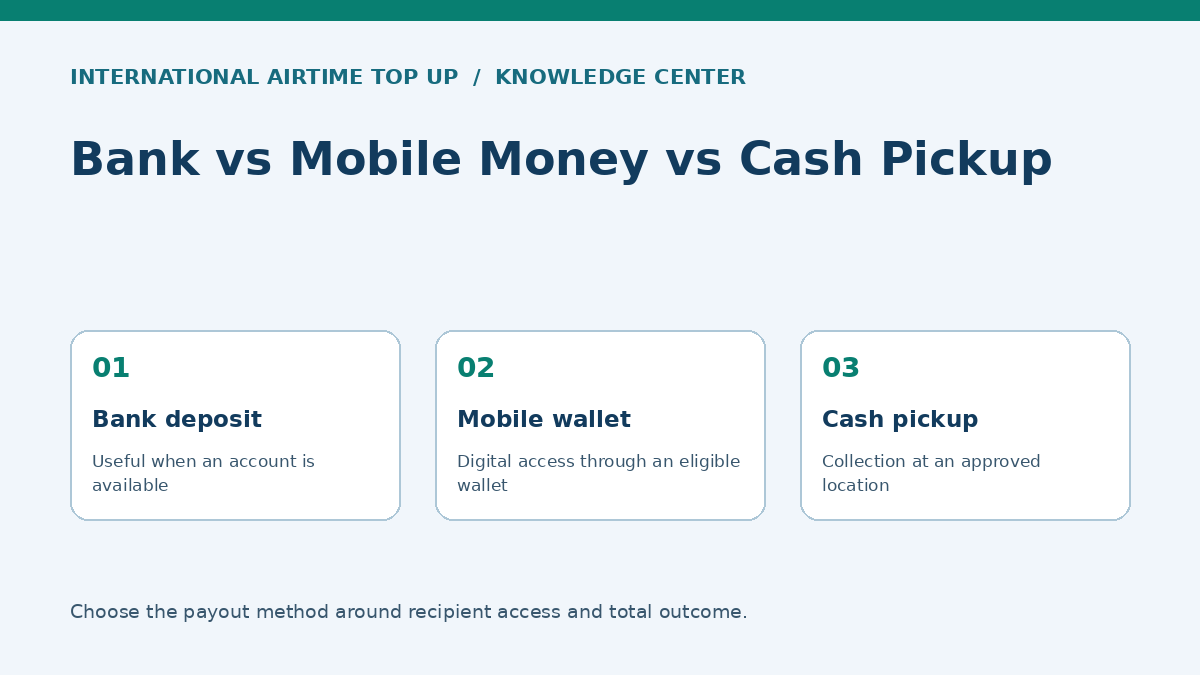
Bank deposit, mobile money and cash pickup at a glance
| Factor | Bank deposit | Mobile money | Cash pickup |
|---|---|---|---|
| Recipient needs | Eligible account and correct bank details | Active eligible wallet and correct mobile number | Accessible payout point, reference and acceptable ID |
| Access after delivery | Account, card, app or branch | Phone, wallet services and agent network | Physical cash after collection |
| Typical strength | Direct account credit and records | Convenient digital access without a bank account | Useful when the recipient needs cash |
| Important risk | Wrong account or bank details | Wrong number, inactive wallet or cash-out cost | Travel, operating hours, ID mismatch or carrying cash |
| Timing dependency | Bank processing, cut-offs, weekends | Wallet/operator availability and limits | Location hours, cash availability and recipient travel |
These descriptions are general. Availability and performance vary by sending country, destination, provider, amount and current partner network. Confirm the live route before promising the recipient a method or time.
When bank deposit is a strong choice
With bank deposit, the provider credits an eligible recipient account. This can be appropriate for rent, school fees, invoices, savings or household spending where the recipient actively uses the account. It provides a transaction trail and may reduce the need to travel with cash.
Information commonly required
- Recipient's full legal name as held by the bank;
- bank name and country;
- account number, IBAN or local equivalent;
- branch, routing, sort, SWIFT/BIC or other code where applicable;
- transfer purpose or payment reference when required.
Do not infer an account number from an old receipt or copy details from an unverified message. Ask the recipient to retrieve current details from the bank's official app, statement or branch. A valid-looking number can still belong to the wrong person.
Limitations
Bank deposits can be affected by cut-off times, weekends, holidays, intermediary routing, compliance review and recipient-bank processing. A recipient may have an account but lack convenient access because a card is blocked, online banking is unavailable or the nearest branch is distant. “Banked” does not always mean “accessible.”
When mobile money is a strong choice
Mobile money stores value in an account linked to a mobile service and identity record. The GSMA distinguishes mobile money from merely using a phone to access a conventional bank account. Depending on the market, a recipient may pay merchants, bills or other users digitally, buy airtime, or withdraw through an authorised agent.
It can be valuable where recipients do not use conventional bank accounts but have reliable phone and agent access. The recipient generally needs an active wallet that is eligible for international receipt, correctly registered and within applicable balance and transaction limits.
Checks before sending
- Confirm the current mobile operator and wallet brand.
- Confirm the full international-format number.
- Ask whether the wallet is active, registered and able to receive the amount.
- Check whether the recipient intends to spend digitally or cash out.
- Include any expected withdrawal fee and agent access in the practical comparison.
Number portability can make the original prefix unreliable. A person may keep a number after changing networks, so confirm the current wallet rather than guessing from the first digits.
When cash pickup is a strong choice
Cash pickup allows an authorised recipient to collect physical currency from a specified agent or branch. It can serve someone without a bank account or eligible wallet, and it can be practical when physical cash is immediately required.
Before sending, confirm that the chosen payout network has an accessible operating location—not merely a national presence. Check hours, acceptable identification, name-matching rules, payout currency, transaction reference requirements and any deadline for collection.
Cash-pickup pre-send checklist
- Enter the recipient name exactly as shown on acceptable ID.
- Confirm the ID is current and accepted at the selected location.
- Verify the location and operating hours through an official source.
- Share the reference privately after confirmation.
- Tell the recipient not to pay a stranger to “release” the transfer.
- Plan safe travel and avoid displaying cash publicly.
Cash availability can vary by location and currency. A “ready for pickup” message does not eliminate the value of checking the location before a long journey. Recipients should use official channels and never surrender the original ID to an unofficial helper.
Four practical payout decisions
Scenario 1: A parent with a working bank account
The recipient pays utilities by bank transfer and uses a debit card locally. Direct deposit reduces the need to travel and preserves a clear record. The sender confirms the current account details and uses the payment reference requested by the bank or biller. Bank deposit is likely the most convenient option even if cash pickup appears marginally faster.
Scenario 2: A rural recipient with strong mobile-money access
The recipient has no conventional bank account but regularly pays merchants through an active wallet and lives near authorised agents. Wallet delivery may provide the best access. The sender still checks the cash-out fee because the recipient may need some physical cash.
Scenario 3: Emergency cash after a lost bank card
A traveller has a bank account but cannot access it because the card and phone were lost. Cash pickup might be suitable if the traveller has acceptable identification and can reach an authorised location safely. The sender independently verifies the request because fraudsters commonly use urgent impersonation stories.
Scenario 4: School fee with an exact reference
A school requires an exact account credit with a student number. Sending money to the student's wallet and asking the student to forward it creates extra steps and possible fees. Direct bank payment may be more reliable if the institution accepts it and the provider can supply the necessary reference.
How payout method affects cost and timing
Compare each method using a live quote for the same amount. Different routes can have different exchange rates, fees, promotions and limits. Include costs that occur after delivery: a wallet cash-out fee, transport to a cash agent, incoming bank charge or intermediary deduction can alter the practical outcome.
No delivery method has one universal timeline. Bank processing can pause at cut-offs; wallets can be affected by operator availability or limits; cash collection depends on agent hours and recipient travel. Provider estimates are conditional, not guarantees. Incorrect names, numbers or account details can delay every route.
| Recipient priority | Method to investigate first | Critical confirmation |
|---|---|---|
| Spend directly from an account | Bank deposit | Usable account and exact details |
| Receive digitally without a bank | Mobile money | Eligible active wallet and limits |
| Obtain physical cash | Cash pickup | Accessible official agent and ID |
| Exact institutional invoice | Bank deposit | Amount, reference and possible deductions |
| Remote area | Depends on local infrastructure | Real bank, agent, wallet and network access |
Safety, errors and troubleshooting
Verify the recipient through a trusted channel before sending, especially when a request is urgent or details have changed. Criminals compromise messaging accounts and redirect genuine family payments. Call a known number or use a pre-agreed question rather than relying only on the message containing new details.
- Bank error: stop and contact official support immediately. Do not send a second payment until the first status is clear.
- Wallet error: confirm number, current operator, wallet status and limits. A completed credit may be difficult to reverse.
- Cash problem: confirm name spelling, ID, reference, location and payout status. Do not post the reference publicly.
- Suspected fraud: contact the provider and payment institution promptly, preserve records, secure accounts and report through the appropriate official channel.
Never ask a recipient to share a password, PIN or one-time code. A legitimate recipient may need a reference and ID for cash collection, but should not need to reveal account-security credentials to the sender or an unsolicited caller.
Seven questions that identify the right method
- Is the method currently available for this exact corridor and amount?
- Which bank account, wallet or cash location can the recipient genuinely access?
- What identity and name-matching requirements apply?
- What are the total sender cost and expected recipient amount?
- Will the recipient pay to withdraw, travel or receive?
- What timing factors could affect this route?
- Which route creates the fewest avoidable steps and safest usable outcome?
Accessibility is more than account ownership
A method exists only if the recipient can use it in practice. A bank account may be dormant, restricted or difficult to reach. A registered wallet may have poor network coverage, a low balance limit or no nearby agent with cash. A cash-pickup brand may operate in the country but not near the recipient. Ask about the exact account, phone, location and intended use rather than relying on national averages.
Disability, literacy, language, age, travel safety and access to identity documents can also shape the decision. A recipient who cannot navigate an app may prefer a trusted bank branch; another who finds travel difficult may benefit from a direct account or wallet credit. The sender should involve the recipient in the choice rather than impose the method with the lowest visible fee.
Limits, names and verification
All three methods can be subject to transaction, daily, monthly or account-balance limits. The provider may request more information as the amount or risk changes. A wallet can reject an otherwise correct transfer if credit would exceed its balance ceiling. A cash agent may apply its own payout threshold or require additional documentation. A bank may review a large or unusual incoming credit.
Name matching deserves special care. Bank and wallet records may include middle names, compound surnames or transliteration differences. Cash pickup often depends directly on an acceptable ID match. Enter the recipient's official name, not a nickname, and ask the provider how to handle punctuation or a legitimate variation. Never alter identity information merely to bypass validation.
Changing circumstances after the transfer
If the recipient loses a phone, closes an account or cannot reach the chosen cash point, contact official support immediately. Whether the method can be changed depends on status, corridor and partner rules. A transfer already credited or collected generally cannot simply be redirected. Do not send a replacement while the first payment remains unresolved.
For recurring support, reconsider the method periodically. A recipient may open a bank account, move to an area with stronger wallet access or face a new local cash-out charge. The most suitable route last year may not be the most suitable route today.
A household decision worksheet
- Recipient's preferred method and reason:
- Exact account, wallet or pickup location:
- Identity and name requirements:
- Total sender payment:
- Expected amount credited or paid:
- Possible withdrawal, incoming or travel cost:
- Estimated availability and operating hours:
- Tracking and support channel:
- Backup plan if the route fails:
Frequently asked questions
Which method is fastest?
There is no universal answer. Corridor, funding, review, partner processing, operating hours and accurate details all affect timing.
Does mobile money require a bank account?
Usually not, but an eligible active wallet registered under the required identity details is generally necessary.
What does a cash recipient need?
Common requirements include acceptable ID, a transaction reference, expected sender details and an exact name match. Check current local rules.
Can I change the method after sending?
Sometimes, depending on provider rules and status. Contact official support immediately; do not duplicate the payment without instruction.
Which method is best in a rural area?
The method with reliable real-world access. Confirm local bank access, mobile coverage, agent liquidity, cash locations and travel distance.
Choose the route your recipient can actually use
Compare available bank, mobile-money and cash-pickup options for the correct destination and recipient details.
Explore transfer optionsAuthoritative sources
- World Bank — Financial inclusion overview
- GSMA — Mobile Money programme and resources
- World Bank — Remittance Prices Worldwide
- FATF — Risk-based approach and financial inclusion
- US FTC — Romance-scam awareness
Information notice: General educational information only. Eligibility, fees, rates, limits, identity requirements, availability and delivery times vary. Confirm the current quote, official payout location and provider terms before sending.