
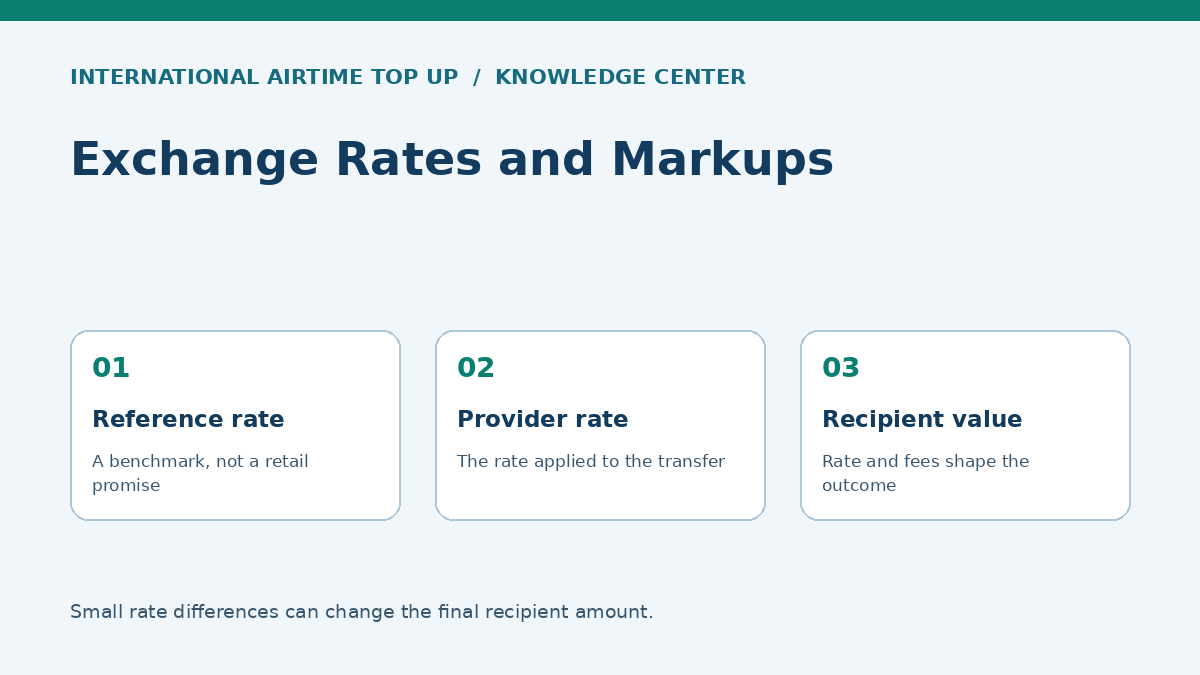
Exchange-rate basics: reference rate, retail rate and recipient amount
An exchange rate states how much of one currency can be exchanged for another. If one unit of the sending currency buys 100 units of the receiving currency, a conversion of 500 sending units would produce 50,000 receiving units before fees or other adjustments.
Foreign-exchange markets contain many rates rather than one universal consumer price. Banks and other market participants buy and sell currencies continuously. News websites may show a mid-market rate—a reference around the midpoint between market buying and selling prices. A transfer provider may instead offer a retail customer rate that reflects its costs, risk, service and revenue. The mid-market rate is therefore useful for comparison, but it is not automatically the rate a customer is entitled to receive.
The binding information is the actual quote: the rate, fee, total payment, expiry time and expected recipient amount shown for the exact transaction. Two providers can display different numerical rates yet produce the same recipient amount after fees; conversely, identical visible fees can conceal materially different conversions.
What is an exchange-rate markup or spread?
In consumer explanations, an exchange-rate markup commonly means the difference between a reference rate and the rate applied to the transfer. A spread can also describe the gap between buy and sell rates. Terminology varies, so do not rely on the label alone. Focus on the arithmetic outcome.
When the currencies are quoted in the same direction, this calculation estimates how far the provider rate is below the reference. It is not a complete transfer-cost measure because a separate fee, card charge, intermediary deduction, tax or recipient charge may also apply.
| Quote element | What it tells you | What it does not tell you alone |
|---|---|---|
| Reference or mid-market rate | A market comparison point at a stated time | The retail rate you will necessarily receive |
| Provider rate | The rate used or offered under stated conditions | The total cost when other fees apply |
| Transfer fee | A separately disclosed charge | The amount embedded in conversion |
| Recipient amount | The destination currency expected before any disclosed later deductions | Whether a local cash-out or recipient fee follows |
| Total sender payment | What the sender pays to the provider | Every possible charge from a card issuer or third party |
Worked example: how the rate changes what arrives
Assume a sender converts 1,000 units. A credible reference observed at the quote time is 1 = 100 destination units. Provider A quotes 98 with no separate fee. Provider B quotes 99.25 and charges a 5-unit fee.
| Provider A | Provider B | |
|---|---|---|
| Amount converted | 1,000 | 1,000 |
| Rate | 98.00 | 99.25 |
| Recipient amount | 98,000 | 99,250 |
| Separate fee | 0 | 5 |
| Total sender payment | 1,000 | 1,005 |
Provider A looks cheaper if the comparison stops at “fee: zero.” Provider B costs five more sending units but delivers 1,250 more destination units in this illustrative example. The sender must decide whether that delivered-value difference justifies the extra payment. These are fictional figures, not live prices.
Now suppose Provider B deducts its fee from the 1,000 rather than adding it. Only 995 is converted, producing 98,753.75 at 99.25. That is still above Provider A's recipient amount, but different from the first interpretation. Always determine whether the entered amount means “I pay this total” or “convert this before fees.”
Rate guarantees, quote windows and market movement
A rate guarantee generally means the provider will hold the quoted rate for a stated time if specified conditions are met. It does not necessarily mean the rate is the most favourable available rate, and it may expire if funding arrives late, the payment method changes, verification is incomplete or the transaction is amended.
Before relying on a guaranteed rate
- Record the exact expiry date, time and time zone.
- Check whether payment must merely be initiated or actually received before expiry.
- Confirm whether weekends, bank holidays or manual transfers affect receipt.
- Check what happens if verification or compliance review continues beyond the window.
- Understand whether cancellation, refund or re-quotation rules apply.
Some services lock the recipient amount at confirmation; others convert when funds arrive or when the payout is processed. Neither model is inherently superior. A locked quote offers certainty, while a later conversion can benefit or disadvantage the sender as markets move. The correct choice depends on the transaction's purpose and the terms clearly disclosed.
Compare quotes at nearly the same time. A Monday quote and a Tuesday quote may reflect a real market move rather than a larger provider margin. Record the source and timestamp of the reference rate, because rates on different sites can update at different intervals.
Real-life scenarios and the questions they reveal
Scenario 1: Monthly family support
A sender budgets 300 units each month for a parent. The parent pays rent and utilities in local currency, so the useful outcome is not the headline rate but the dependable recipient amount. The sender compares two live quotes every few months, including normal pricing after any first-transfer promotion. A small recurring rate difference can accumulate across twelve transfers.
The lesson is to compare a representative normal transaction, not build a household budget around a temporary promotional rate.
Scenario 2: An exact tuition payment
A school invoice requires exactly 250,000 destination-currency units. The sender should work backwards from the required recipient amount, check whether intermediary deductions are possible, include the correct payment reference and confirm the quote window. Sending a convenient round number in the origin currency can leave the invoice short.
For exact institutional payments, certainty and reconciliation may matter more than saving a small fixed fee.
Scenario 3: A rapidly moving currency
A sender saves a quote in the morning but pays in the evening after the guarantee expires. The recipient amount is lower. That change is not automatically evidence of hidden pricing: the market, provider rate or both may have moved. The sender should compare the confirmation screen with the expired quote and ask support about any unexplained difference before paying.
Scenario 4: “Zero fee” social-media advertisement
An advertisement highlights a zero transfer fee but does not show a recipient amount. On the official quote page, the retail conversion produces less destination currency than another provider charging a visible fee. The sender uses the official sites, obtains simultaneous quotes and selects based on delivered value and service conditions.
The UK Financial Conduct Authority has specifically illustrated how emphasising a zero fixed fee without making the exchange-rate difference clear can create a misleading impression. The practical response is careful comparison, not an assumption that every zero-fee promotion is poor value.
A fair exchange-rate comparison method
- Use the same corridor and currencies. Direction matters: sending A to B is not equivalent to sending B to A.
- Use the same amount. Providers may use pricing tiers.
- Use the same funding method. A card-funded quote may differ from bank funding.
- Use the same payout method. Bank deposit, wallet and cash pickup can have different pricing.
- Quote close together. Record date, time and time zone.
- Record the reference rate. Use a credible, timestamped source consistently.
- Record total paid and amount received. These capture the practical outcome better than a rate in isolation.
- Check later charges. Ask about intermediaries, recipient institutions and wallet cash-out.
- Check the guarantee conditions. Note expiry and funding requirements.
- Compare service quality. Eligibility, support, delivery estimate, tracking and refund terms also matter.
The World Bank's Remittance Prices Worldwide programme measures both transfer fees and exchange-rate margins when assessing remittance costs. This supports a total-cost comparison rather than a headline-fee comparison. The US Consumer Financial Protection Bureau's remittance rules also illustrate the importance of disclosing exchange rates, covered fees and the amount expected to be received, although legal coverage and consumer rights vary by jurisdiction.
Common exchange-rate comparison mistakes
- Comparing opposite quote directions. “Currency per unit” and “units per currency” can make a numerically larger rate worse rather than better.
- Comparing at different times. Market movement can invalidate the conclusion.
- Ignoring the amount converted. A fee deducted before conversion changes the base.
- Using a search snippet as a binding quote. A market-information rate is not a provider commitment.
- Assuming a guarantee lasts indefinitely. Check the clock and funding deadline.
- Ignoring payout differences. A cash quote and wallet quote are not like-for-like.
- Chasing a suspiciously favourable rate. Verify that the provider and web address are legitimate; an unrealistic rate can be bait for fraud.
- Splitting transfers to avoid checks. Do not structure payments to evade legitimate verification or reporting obligations.
What can legitimately make retail rates differ?
A difference from a reference rate is not automatically an improper charge. A provider may need to obtain currency, manage rapid price movement, maintain payment and compliance systems, fund customer support, connect to payout partners and cover failed-payment or fraud risk. A small transfer, unusual currency pair or route with limited liquidity can be priced differently from a large transfer between heavily traded currencies.
The relevant consumer question is whether the complete price and outcome are presented clearly enough for an informed decision. A transparent provider can use a retail rate while showing the sender total, the applied rate, the separate fee and the expected recipient amount. A confusing presentation can make comparison difficult even if each individual number appears somewhere.
Direct and indirect currency routes
Some transfers may involve more than one conversion. If a provider or intermediary converts sending currency into an intermediate settlement currency and then into destination currency, two conversion effects may arise. The customer-facing provider should explain the quoted outcome and known deductions, but the sender should still ask whether the recipient amount is fixed and whether another institution can convert or deduct funds.
Weekends, holidays and after-hours quotes
Markets and settlement systems do not operate identically at all times. A provider may adjust pricing or the duration of a guarantee when markets are closed or liquidity is thinner. This does not make a weekend quote inherently poor; it makes the quote time and expiry conditions important. If the transfer is not urgent, the sender can compare again when normal market activity resumes.
Promotional rates
A first-transfer rate can be attractive but temporary, capped or limited to selected customers and corridors. Record both the promotional quote and the ordinary price that will apply to future transfers. Recurring senders should evaluate sustainable delivered value rather than treating a one-time incentive as the long-run rate.
How to document a quote when the amount matters
For tuition, medical care, property, supplier or other high-consequence payments, save the confirmation screen, timestamp, expiry, rate, fee, sender total, recipient amount, payout instructions and reference. Check the recipient name and account separately. If a discrepancy occurs, this record helps the provider distinguish an expired quote, changed input, third-party deduction or processing error.
Do not rely only on a screenshot that omits the web address, time or conditions. Download the official receipt where available. If the recipient must receive an exact sum, ask whether the quoted amount is guaranteed after all known charges and who bears any shortfall. Professional advice may be appropriate for large commercial, tax-sensitive or regulated transactions.
Frequently asked questions
What is an exchange-rate markup?
It is the difference between a reference exchange rate and the retail rate used for a customer transaction. It can reduce the destination currency produced.
Is the mid-market rate the rate I will receive?
Not necessarily. It is a comparison reference. The binding quote is the rate and recipient amount offered for your exact transaction.
How do I compare rates fairly?
Compare live quotes close together for identical amounts, currencies, funding and payout methods. Record total paid and final recipient amount.
What does a guaranteed rate mean?
It normally means the rate is held for a stated period subject to conditions. Check expiry, funding deadline and what causes re-quotation.
Can the recipient amount change?
It depends on the service. Some amounts are fixed at confirmation; others are converted later. Disclosed third-party deductions may also affect the credit.
Compare the amount delivered
Use a live quote to review the rate, total sender payment, expected recipient amount, payout method and delivery conditions together.
Explore money transfer optionsAuthoritative sources
- World Bank — Remittance Prices Worldwide methodology and purpose
- US CFPB — Remittance-transfer disclosures
- UK FCA — International-payment pricing transparency
- Bank for International Settlements — Exchange-rate statistics
- Australian ACCC — Foreign currency and money exchange
Information notice: This article is general education, not financial, legal, tax or regulatory advice. Rates, markups, fees, availability and delivery conditions vary by time, provider, corridor, amount and method. Worked figures are illustrative, not live quotations.