
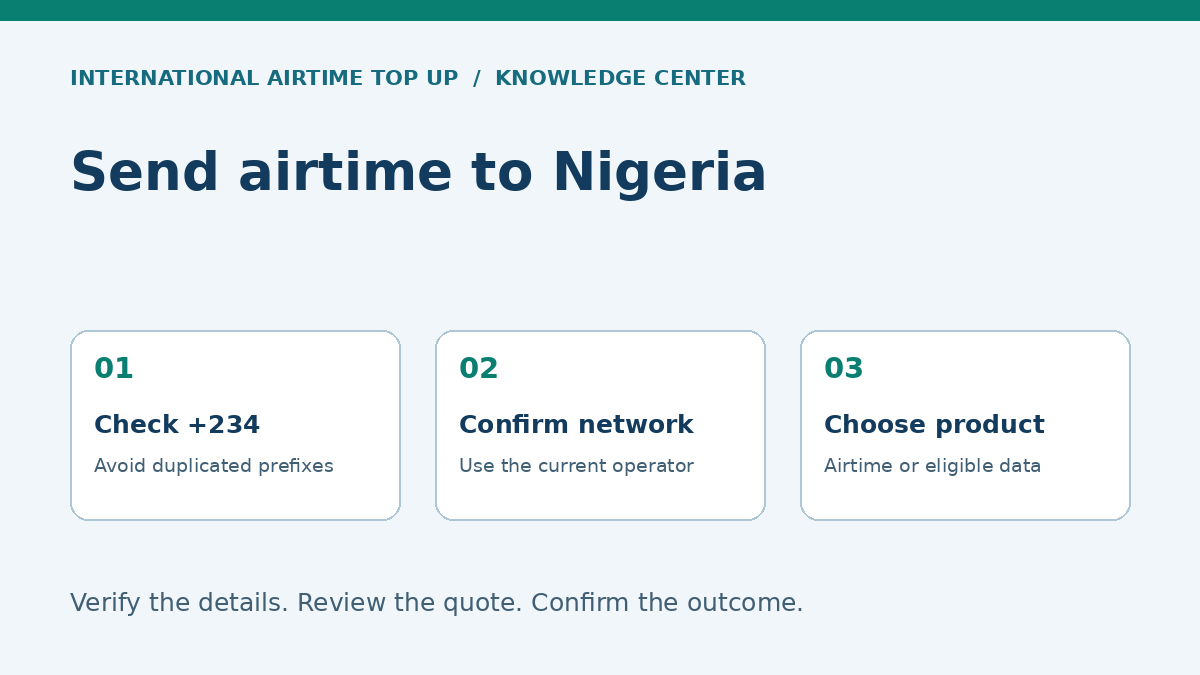
Sending airtime to Nigeria: what you are buying
An international airtime top-up purchases mobile-service credit or a specified bundle for an eligible Nigerian number. It is not a bank transfer, cash payment or automatically a mobile-money credit. Before sending, ask whether the recipient needs general airtime, a data allowance or a particular voice-and-data product. The distinction determines whether the purchase will actually meet the need.
A relative studying online may prefer data with a suitable validity period. Someone who mostly makes ordinary calls may prefer flexible airtime. A traveller using a Nigerian SIM abroad needs to check roaming eligibility; a domestic bundle may not work outside Nigeria. Choose the product after confirming the use case, rather than assuming the largest bonus is the best value.
The process is straightforward when the country, number, current network and product are correct. Completed airtime is often difficult to reverse, making the final review screen especially important. For the general concept, read what international airtime top-up means.
Nigerian mobile-number format and the +234 code
Nigeria's international calling code is +234. For an ordinary Nigerian mobile number written domestically with an initial zero, the international form normally replaces that domestic zero with +234. The remaining mobile-number portion is ten digits. Check the form's instructions because some services insert the country code automatically.
Use a masked pattern when discussing the format: 080X XXX XXXX becomes +234 80X XXX XXXX. This is a pattern, not a number to copy into an order. If the form already displays +234, do not add 234 a second time. Do not keep the domestic zero unless the form explicitly asks for domestic formatting.
The ITU's national numbering-plan directory identifies Nigeria under +234 and links to official numbering information. Number-format validation does not prove that the intended person controls the number or that it can receive the product. Confirm the full number directly with the recipient. Source: ITU national numbering plans.
Choose the current network, not a remembered prefix
Nigerian customers may use MTN, Airtel, Globacom or another supported operator. The actual list available for international top-up depends on the provider's current catalogue and partnerships. Do not treat a network name mentioned in a guide as a guarantee that every product for that network is available at checkout.
Where mobile number portability is used, the original prefix may no longer identify the current serving network. Ask the recipient which operator now serves the SIM. If the top-up platform detects a network, compare it with the recipient's answer. Stop if there is a discrepancy instead of choosing whichever name looks familiar.
Network branding can change and partner catalogues may retain older labels temporarily. If the recipient's current brand differs from the displayed option, ask official support which product applies. Do not select a similarly named network from another country. Country and operator are separate checks, and both must be correct.
Airtime, data and bonus balances
| Product | What to check | Common mistake |
|---|---|---|
| General airtime | Core credit value, permitted uses and any deductions under the recipient's plan. | Assuming it automatically activates a data bundle. |
| Data bundle | Allowance, validity, activation and eligible plan. | Buying a short-lived or restricted bundle for a longer need. |
| Voice or combined bundle | Included destinations, minutes, texts and data conditions. | Assuming all calls and usage are included. |
| Promotional bonus | Eligibility, expiry, balance category and permitted use. | Adding headline bonus value to ordinary airtime as if it were unrestricted. |
Operator product rules are the controlling reference for consumption. MTN Nigeria, for example, publishes separate recharge and data-bundle information, illustrating why credit purchase and data-plan activation should be checked separately. Do not apply one operator's instructions to every Nigerian SIM. MTN recharge information and MTN data-bundle guidance provide operator-specific starting points.
Step-by-step sending process
- Confirm the recipient's identity, full number, current operator and intended product.
- Open the official top-up service using a trusted device and verified address.
- Select Nigeria as the SIM's destination country.
- Enter the number in the form's required format and check every digit.
- Confirm the operator and choose an available eligible airtime value or bundle.
- Review the sender price, currency, fees, recipient value and product conditions.
- Complete payment within the official checkout and retain the order reference.
- Ask the recipient to verify the actual balance or bundle after final delivery confirmation.
If the recipient is physically outside Nigeria but using a Nigerian SIM, Nigeria remains the relevant SIM destination. Roaming compatibility is a separate product question. For a dual-SIM phone, ask which exact number should receive the value; the contact number used for messaging might not be the data SIM.
The step-by-step international airtime guide explains general payment and confirmation steps. Screen labels may differ between providers, so follow the current product interface without assuming a particular button sequence.
Comparing sender price and recipient value
The sender may pay in pounds, euros, dollars or another supported currency while the recipient receives a naira-denominated credit or an allowance of data. Those figures should not be compared numerically without considering currency and product. The price can include service charges, conversion effects and operator-defined denominations.
For example, two fictional offers can cost the sender the same amount while one supplies general airtime and the other supplies a restricted data bundle. Neither is automatically better. Compare usable allowance, validity, eligibility and the recipient's actual consumption. A bundle expiring before the recipient can use it may offer less practical value than a smaller flexible purchase.
Save the product description and confirmation, particularly when buying a promotion. Do not rely on a screenshot of an old offer. Bonuses may depend on the SIM's tariff plan, recharge channel or eligibility and may appear in a separate balance. This guide deliberately does not publish fixed prices or promotional percentages as permanent promises.
Delivery confirmation and balance checking
The sender's payment acknowledgement is not always the final operator delivery acknowledgement. A transaction can move through payment accepted, processing and completed states. If the order is still pending, wait for the stated window or contact support; submitting the same order again may create a duplicate purchase.
Ask the recipient to check the actual balance using the operator's official app or current USSD instructions. The NCC's harmonised short-code announcement identifies 310 for balance checking and 300 for customer care, but the recipient should follow the operator's current instructions for the relevant account or bundle. An international electronic top-up does not normally require entering a physical recharge-card PIN. Source: NCC short-code announcement.
A missing text message is not proof of missing value. Equally, an image of a message is not sufficient proof that the correct number was credited. Check the operator balance or transaction record directly and retain the sender's receipt for a support enquiry.
Why delivered value can look smaller than expected
The recipient may be looking at a different balance category, or a bundle may have been activated rather than general airtime added. Ongoing data use or calls can consume value before the recipient checks it. Depending on the recipient's operator and plan, an existing airtime-advance obligation or an authorised renewal can also affect available credit; verify the actual operator record instead of assuming theft or a platform error.
Ask the recipient what balance was present before purchase, what product was selected and what activity occurred afterwards. If possible, compare the transaction time with the operator's messages. This helps distinguish non-delivery from successful delivery followed by use, deductions or movement into a separate bundle balance.
Do not automatically buy more airtime to resolve an unexplained discrepancy. First identify the product and account behaviour. Otherwise a recurring subscription, unsuitable plan or incorrect SIM selection may consume another purchase in the same way.
Troubleshooting unsuccessful or delayed top-ups
| Problem | First check | Next action |
|---|---|---|
| Number rejected | Country code, length and duplicated prefix. | Confirm the number with the recipient before retrying. |
| Operator mismatch | Current serving network and possible portability. | Ask official support if detection remains inconsistent. |
| Pending order | Payment state and stated processing window. | Avoid duplicates; follow the existing reference. |
| Completed but no value seen | Correct SIM, balance type and operator record. | Provide the receipt to verified support. |
| Inactive or restricted SIM | Recipient's service status. | Resolve the restriction with the operator; recharge may not fix it. |
An identity-registration or service restriction is separate from account balance. Adding credit does not guarantee reactivation. The recipient should complete any legitimate operator process themselves, without sharing identity documents with an unknown “activation agent” encountered through social media.
Four Nigerian airtime scenarios
Supporting a student before online classes
A parent confirms the student's data SIM, network and required validity. They choose an eligible bundle covering the planned study period and ask the student to confirm activation. The parent does not assume that general airtime automatically provides the same data allowance or that a promotional bonus applies to the student's plan.
A relative with two active SIMs
A relative receives messages on one number but uses another network for data. The sender asks which SIM should receive the purchase and checks the international-format number at checkout. Saving the recipient as “data SIM” can help later, but the details should be rechecked when circumstances change.
A top-up while the recipient is roaming
A traveller abroad asks for credit on a Nigerian SIM. The sender selects Nigeria and the home operator, then confirms whether the chosen product supports roaming. A domestic-only bundle could be delivered successfully while failing to meet the traveller's connectivity need.
A completed order with no SMS alert
The recipient sees no notification and asks the sender to repeat the purchase. Instead, both check the original order status and the operator balance. If the value is present, no second purchase is necessary. If absent, the original reference provides a clear starting point for investigation.
Wrong numbers, refunds and privacy
Contact support immediately if you discover a wrong number. Recovery may be possible before final operator acceptance, but a completed recharge to a valid number can be irreversible. Do not promise yourself that a card dispute will automatically reverse a correctly processed airtime purchase; describe the facts accurately to the provider and funding institution.
Keep receipts private. When raising a support case, provide the transaction reference and necessary recipient details through the official channel, not public comments. Never disclose a PIN, password or one-time payment code. If an unexpected message asks you to top up a new number urgently, independently confirm the request with the person you know.
For repeated support, keep a simple record of date, masked number, network, product, value and validity. That record helps compare value and identify duplicates without storing payment credentials. Reconfirm the current network and preferred product periodically, because a saved contact can outlast the recipient's plan or SIM arrangement.
Match a data bundle to the recipient's pattern of use
A data purchase should be evaluated by more than the headline allowance. Ask whether the recipient needs access over a day, a week or a longer period; whether the allowance works across ordinary applications; and whether any portion is restricted by time or service. A large short-validity bundle can be a poor fit for someone whose use is spread across a month.
Consider the device and connectivity conditions as well. A successful purchase cannot fix an unsupported handset, weak coverage or a disabled data setting. If the recipient reports that data does not work, confirm the correct SIM is selected for mobile data and ask them to follow official operator troubleshooting. Do not automatically treat every connectivity problem as non-delivery.
Some plans renew automatically under their own terms. The recipient should understand any renewal setting and how to manage it through the operator. A sender purchasing a one-off product should not assume that the recipient's wider account has no recurring services. Clear communication about the existing plan helps prevent unexpected balance changes after a top-up.
Keep the sender and recipient records aligned
After purchase, compare three details: the number that was credited, the product that was delivered and the time it was recorded. A sender's receipt may describe an operator product differently from the recipient's notification. If the allowance and validity do not appear consistent, ask support to explain the mapping before making another purchase.
Keep a short record for repeat top-ups without collecting unnecessary private information. Date, masked number, operator, selected product, sender price and recipient confirmation are usually more useful than a folder of unlabelled screenshots. Never store the recipient's service PIN or your card security code alongside those records.
When a purchase was intended as a gift, ask the recipient to confirm it privately. Posting a receipt publicly can reveal a phone number, transaction reference or account information. There is no need to expose those details to demonstrate that support was sent.
What to ask support when a completed top-up is disputed
Provide the original reference, displayed number, operator, product and completion time. Explain whether the recipient checked general airtime, bonus credit or data balance and whether any related operator message appeared. Ask whether the operator confirmed delivery and whether a partner reference is available.
Avoid changing the description between support messages. Saying “no data” in one message and “no airtime” in another can lead the investigation toward different products. State exactly what was ordered and what is missing. If support confirms successful delivery to the wrong number, ask about recovery honestly; do not describe the transaction as unauthorised if you approved it but entered incorrect details.
Frequently asked questions
How do I enter a Nigerian mobile number internationally?
Use +234 followed by the mobile number without its domestic leading zero, unless the form explicitly requests another format. Do not enter the country code twice.
Can I identify the network from the prefix alone?
Do not rely on the prefix alone. Confirm the current operator with the recipient, especially where the number has been ported.
Is airtime the same as a data bundle?
No. General airtime and specific bundles can have different uses, activation rules and validity. Select the product the recipient actually needs.
Does a top-up reactivate a restricted SIM?
Not necessarily. The recipient must resolve service or registration restrictions through the operator's official process.
What if I sent airtime to the wrong number?
Contact official support immediately. A completed operator recharge may be irreversible, so cancellation or refund cannot be guaranteed.
Review your available options
Check the current destination, recipient requirements, total price and delivery conditions before confirming.
Explore available servicesSources and further reading
- ITU: national numbering plans
- NCC: harmonised short-code announcement
- MTN Nigeria: recharge information
- MTN Nigeria: data-bundle guidance
Information notice: General educational information, not individual financial, legal or regulatory advice. Eligibility, fees, exchange rates, limits, products and delivery conditions can change. Confirm the current provider and recipient requirements before payment. Illustrative figures and scenarios are not live quotations or customer case reports.