
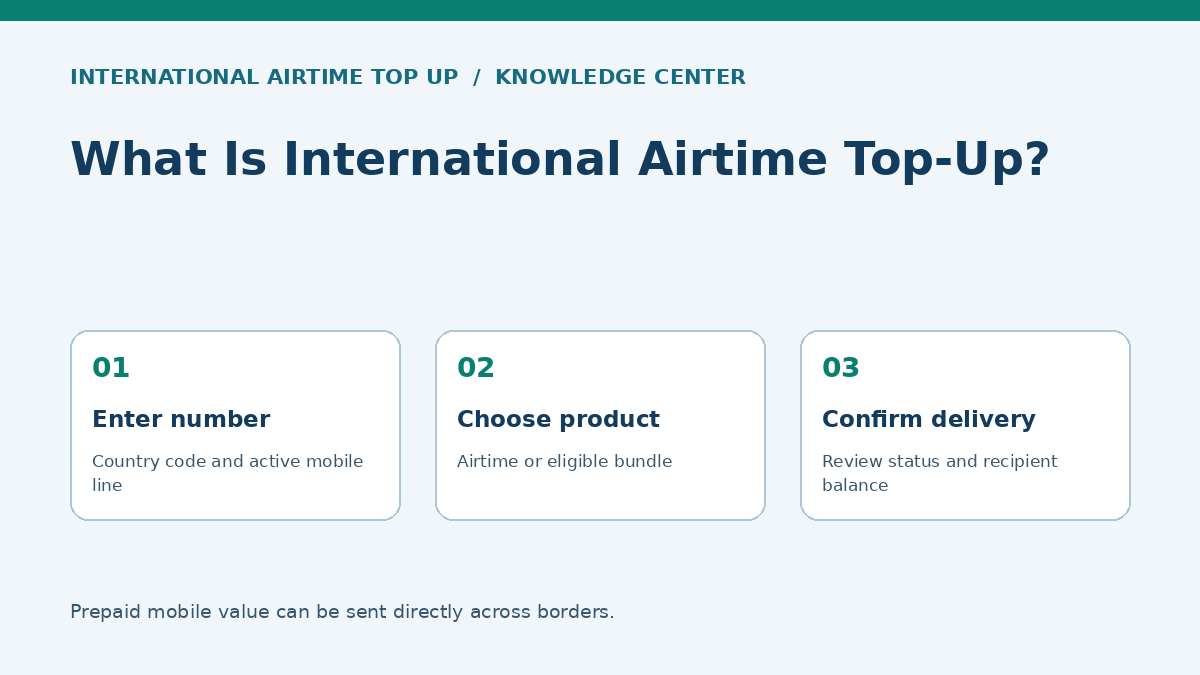
What is international airtime top-up?
International airtime top-up—also called international mobile recharge—allows a person to buy prepaid mobile value for a supported recipient number. The sender selects the destination and mobile number, chooses an available airtime amount or bundle, pays online, and the service submits the top-up through the relevant operator or distribution partner.
The recipient does not normally receive transferable cash. Instead, the operator applies value to the prepaid mobile account under its own rules. That value may be usable for calls, text messages, data purchases or other operator services, depending on the plan and country.
The service is “international” because the sender, payment method or platform can be outside the recipient's country. The underlying recharge still ends at a specific domestic mobile account. Supported countries, networks, denominations and products can change, so the live product screen is more reliable than an old article or screenshot.
How international top-up works from sender to phone
- Destination selection. The sender chooses the country associated with the recipient's mobile service.
- Number entry. The full number is entered in the format requested, usually with the country code.
- Operator validation. The service may identify the network automatically or require the sender to select it. Number portability can complicate prefix-based detection.
- Product selection. Available airtime values, data bundles or operator promotions are displayed.
- Price review. The sender reviews the payment amount, currency, any fee, recipient number, operator and product.
- Secure payment. The sender uses a supported method through the official checkout.
- Submission and operator response. The platform sends the request into the recharge network and records a status.
- Delivery confirmation. The sender may receive a receipt or status update; the recipient may receive an operator message or verify the balance directly.
“Completed” usually means the recharge network or operator accepted the transaction. It does not necessarily mean the recipient read an SMS. Messages can be delayed or filtered, so balance verification may be more reliable.
Airtime, data bundles and money transfers are different
| Product | What arrives | Typical use | Can it normally be withdrawn as cash? |
|---|---|---|---|
| Airtime | Prepaid mobile-service credit | Calls, texts, or operator purchases | No |
| Data bundle | A defined data allowance, often with validity conditions | Internet access | No |
| Mobile-money transfer | Value in an eligible mobile wallet | Payments, transfers and sometimes agent withdrawal | Often possible under wallet rules |
| Bank or cash transfer | Money in an account or physical cash | General financial use | Yes, subject to method |
Do not send airtime when the recipient needs rent money, school fees or cash unless the recipient specifically confirms that airtime is the intended support. Informal resale of airtime can create loss and risk and may breach operator terms.
Likewise, do not assume “top-up” means data. Some bundles activate immediately and expire after a defined period; others add airtime from which the recipient can buy a preferred plan. Confirm the product label, allowance, validity and eligibility before payment.
Why families and travellers use international airtime
- Keeping in touch. A relative can help a recipient maintain voice or data access.
- Supporting essential coordination. Mobile value can help with job searches, school communication, appointment coordination or emergency contact.
- Helping a traveller. A sender may recharge a supported prepaid SIM when the traveller cannot easily pay locally.
- Gifting. Airtime or data can be a practical small gift when the sender knows the recipient's needs.
- Direct-use support. The sender can provide a specific communications resource rather than unrestricted cash.
These uses should not be overstated. Airtime is not a substitute for emergency services, stable connectivity or financial support. Coverage, handset compatibility, SIM status and operator rules still determine whether the recipient can use it.
How delivery and confirmation work
Many top-ups are processed quickly because they are electronic, but no responsible guide should promise universal instant delivery. Payment authentication, fraud review, operator maintenance, partner outages, network congestion, an inactive SIM or incorrect details can delay or prevent completion.
| Status | Likely meaning | Action |
|---|---|---|
| Pending/processing | Payment or operator response is not final | Wait for the stated window; avoid duplicate payment |
| Completed/successful | The transaction was accepted as delivered | Ask recipient to check balance or bundle directly |
| Failed | Top-up was not completed | Review refund/payment status and official instructions |
| Under review | Payment or account verification may be required | Use only the official site or support channel |
Keep the receipt and transaction reference. If the status is successful but the recipient sees no value, confirm the exact number and product, ask the recipient to use the operator's official balance method, restart the handset if appropriate, and contact official support with the reference.
Practical international airtime scenarios
Scenario 1: A student needs data, not general airtime
A parent abroad wants to help a student attend online classes. The parent first asks which network the student currently uses and whether a specific data bundle works with the student's plan. Buying a 30-day data bundle may meet the need more directly than sending the same face value as airtime, but only if the allowance and validity are clearly displayed.
Scenario 2: A ported number
A recipient's number begins with a prefix historically associated with Network A, but the recipient moved to Network B while keeping the number. The sender does not guess from the prefix; the recipient confirms the current operator and the sender checks the checkout information. This reduces the chance of rejection or misrouting.
Scenario 3: A traveller using roaming
A traveller has a prepaid SIM from home and is roaming abroad. A successful top-up adds value to the home operator account, but roaming prices and bundle eligibility may differ. The sender confirms that the product can be used while roaming; a domestic-only data bundle may otherwise be of little help.
Scenario 4: An urgent message claiming a changed number
A social-media account asks a sender to top up a new number immediately. The sender calls the relative on a previously known number and discovers the account was compromised. Because airtime can be consumed quickly and may be irreversible, identity verification is as important for recharge as for money transfer.
Important limits and common mistakes
- Wrong country or country code: the number may resolve to a different destination or fail validation.
- Domestic formatting: retaining or removing a leading trunk zero incorrectly can change the number.
- Wrong operator: prefixes can be outdated after number portability.
- Airtime/data confusion: a data bundle may expire or be ineligible; airtime may not include data.
- Postpaid instead of prepaid: some recharge products support only eligible prepaid accounts.
- Inactive or barred SIM: credit may not restore a service restricted for registration, identity or other reasons.
- Duplicate purchase: resubmitting while a transaction is pending can create two successful top-ups.
- Assumed reversal: once the operator accepts value, reversal can be impossible.
Operator promotions may change the bonus, validity or permitted use. Treat the details shown at checkout as transaction-specific and save the confirmation. Do not promise a bonus based on an old advertisement.
Safer online top-up practices
- Use the official HTTPS website or app and type or bookmark the address.
- Use a trusted device and update its browser and operating system.
- Avoid entering payment details over public or untrusted Wi-Fi.
- Use a unique password and multi-factor authentication where offered.
- Never share passwords, card PINs or one-time verification codes.
- Review country, full number, operator, product and total before confirming.
- Keep the receipt but do not publish transaction references.
- Verify unexpected urgent requests through an independent channel.
The US Federal Trade Commission warns that scammers frequently impersonate trusted people and create urgency. Although many warnings concern money, the same verification principle applies to airtime because digital value can be used rapidly.
Understanding price, face value, currency and bonuses
The amount the sender pays need not equal the numerical airtime value shown to the recipient. The currencies differ, and the platform may apply a conversion, fee or operator-defined denomination. Review both sides of the order: the sender price and currency, and the exact mobile value or bundle the recipient is expected to receive.
A bonus can have different rules from the core airtime. It may be limited to on-network calls, data, selected hours or a short validity period. It may also be available only to eligible numbers. Treat a bonus as conditional until the live checkout clearly states the allowance and terms. Do not calculate value by adding an old promotional percentage found in a search result.
Fixed denominations can also produce a different effective price per unit. Compare the complete product rather than assuming the largest denomination is automatically best. Sending more than the recipient can use before expiry wastes value, while repeated small purchases may incur repeated fees.
Roaming, dual-SIM phones and inactive numbers
A phone's physical location does not change the home network attached to its SIM. When a recipient travels, select the SIM's home country and operator, then check whether the resulting airtime or bundle works while roaming. Domestic-only data may not work abroad, and roaming rates can consume general airtime quickly.
Dual-SIM devices create another common error. A recipient may use one number for calls and another for data. Ask which exact SIM should receive the value. Labelling contacts “personal” and “data” does not establish operator eligibility.
A dormant, expired, barred or registration-restricted SIM may not accept or use a recharge normally. Top-up should not be presented as a guaranteed way to reactivate service. The recipient should resolve account restrictions directly with the mobile operator using official channels.
Top-up records and household budgeting
For recurring family support, keep a simple record of date, recipient number ending, operator, product, sender cost, recipient value and validity. This helps detect duplicate purchases, compare bundles and understand whether the recipient repeatedly runs out before expiry. Avoid storing full payment-card data in the record.
A conversation with the recipient is often more useful than repeatedly increasing the amount. The issue may be background data use, roaming, an unsuitable bundle or poor coverage rather than insufficient value. An appropriate product can be more useful than a larger but mismatched recharge.
When airtime is not the right tool
Choose another service when the recipient needs cash, must pay an institution that does not accept mobile credit, requires a specific mobile-money wallet balance, or cannot use the supported operator. Airtime is purpose-specific digital value. Calling it a substitute for remittance can confuse customers and create an unsuitable purchase.
Frequently asked questions
What is international airtime top-up?
It is the purchase of prepaid mobile credit or an eligible bundle for a supported number, often from another country.
Can airtime be withdrawn as cash?
Normally no. Airtime is mobile-service credit, not a money-transfer balance.
Is airtime the same as data?
Not always. Airtime and data bundles are distinct products, though some operators allow airtime to purchase data.
How quickly is delivery?
Many transactions process rapidly, but timing is not guaranteed and depends on payment, operator and network conditions.
Can a wrong-number top-up be reversed?
Often not after operator acceptance. Contact official support immediately, but verify all details before payment.
Send the right mobile value to the right number
Check the destination, complete number, current operator and exact airtime or data product before paying.
Explore international airtimeAuthoritative sources
- International Telecommunication Union — Connectivity facts and figures
- GSMA Mobile for Development — Mobile connectivity resources
- GSMA — Mobile money resources
- US FTC — Impersonation scam guidance
Information notice: General educational information only. Supported countries, operators, products, prices, bonuses, validity, payment methods and delivery conditions can change. Review the live product details and provider terms before purchase.