
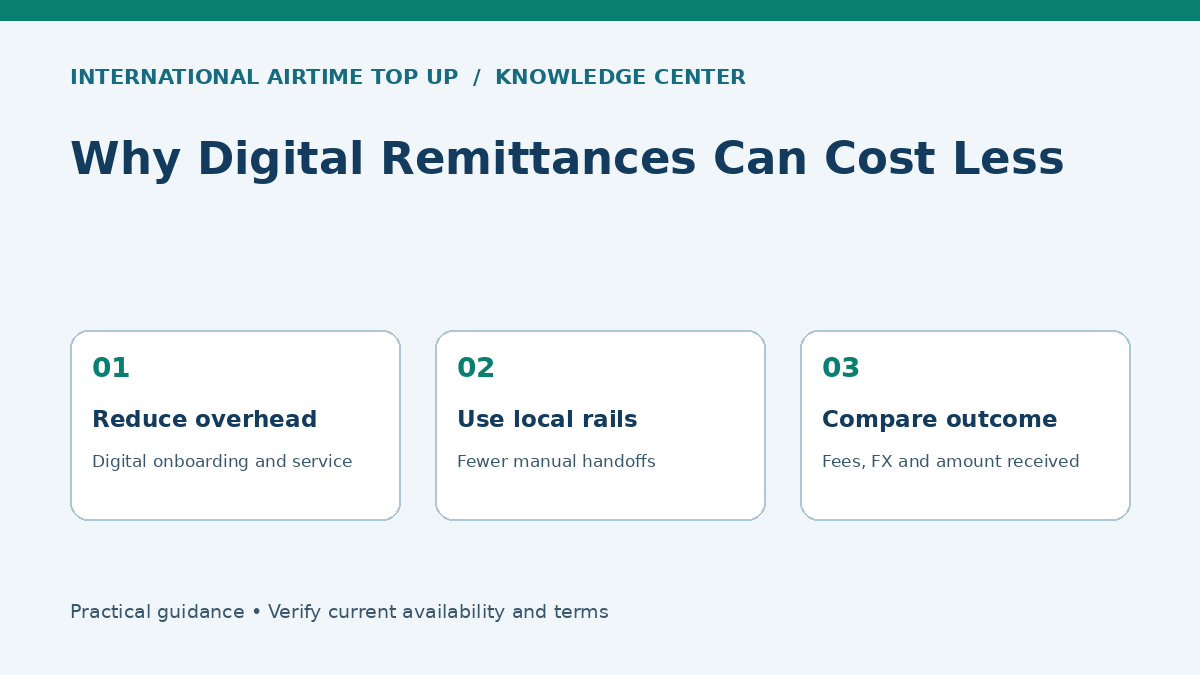
What total remittance cost includes
The comparison should combine explicit fees, exchange-rate margins and predictable client- or person receiving-side charges. In the context of why digital remittances can cost less than traditional bank transfers, this point should be assessed as part of the full service journey rather than as a standalone feature.
The practical test is whether it advances the objective to compare the complete cost of a digital remittance with a traditional international bank-transfer channel without relying on the headline fee alone. Examine sending amount, explicit fee, exchange rate, markup or spread, intermediary deductions, person receiving amount, funding charge, payout charge and realistic delivery estimate. The answer may differ by payment service, country, amount, client and time, so a general capability should never be presented as a universal promise.
A useful control is to compare total cost, rate transparency, intermediary charges, funding expense, payout expense, speed, limits, provider assistance, refund process and amount supported to the person receiving. Record what is known, identify assumptions and escalate uncertainty through official channels before acting. This keeps the analysis focused on real client outcomes rather than technology labels or marketing shorthand.
Digital onboarding and servicing
Remote registration and self-service can reduce some branch and paper costs while introducing technology, verification and provider assistance expenses. In the context of why digital remittances can cost less than traditional bank transfers, this point should be assessed as part of the full service journey rather than as a standalone feature.
The practical test is whether it advances the objective to compare the complete cost of a digital remittance with a traditional international bank-transfer channel without relying on the headline fee alone. Examine sending amount, explicit fee, exchange rate, markup or spread, intermediary deductions, person receiving amount, funding charge, payout charge and realistic delivery estimate. The answer may differ by payment service, country, amount, client and time, so a general capability should never be presented as a universal promise.
A useful control is to compare total cost, rate transparency, intermediary charges, funding expense, payout expense, speed, limits, provider assistance, refund process and amount supported to the person receiving. Record what is known, identify assumptions and escalate uncertainty through official channels before acting. This keeps the analysis focused on real client outcomes rather than technology labels or marketing shorthand.
Funding method economics
Bank-account funding, cards and other methods have different processing costs, failure risks and consumer protections. In the context of why digital remittances can cost less than traditional bank transfers, this point should be assessed as part of the full service journey rather than as a standalone feature.
The practical test is whether it advances the objective to compare the complete cost of a digital remittance with a traditional international bank-transfer channel without relying on the headline fee alone. Examine sending amount, explicit fee, exchange rate, markup or spread, intermediary deductions, person receiving amount, funding charge, payout charge and realistic delivery estimate. The answer may differ by payment service, country, amount, client and time, so a general capability should never be presented as a universal promise.
A useful control is to compare total cost, rate transparency, intermediary charges, funding expense, payout expense, speed, limits, provider assistance, refund process and amount supported to the person receiving. Record what is known, identify assumptions and escalate uncertainty through official channels before acting. This keeps the analysis focused on real client outcomes rather than technology labels or marketing shorthand.
Settlement and local payout rails
A payment service may use local accounts or partners rather than sending each payment as an individual correspondent-bank wire. In the context of why digital remittances can cost less than traditional bank transfers, this point should be assessed as part of the full service journey rather than as a standalone feature.
The practical test is whether it advances the objective to compare the complete cost of a digital remittance with a traditional international bank-transfer channel without relying on the headline fee alone. Examine sending amount, explicit fee, exchange rate, markup or spread, intermediary deductions, person receiving amount, funding charge, payout charge and realistic delivery estimate. The answer may differ by payment service, country, amount, client and time, so a general capability should never be presented as a universal promise.
A useful control is to compare total cost, rate transparency, intermediary charges, funding expense, payout expense, speed, limits, provider assistance, refund process and amount supported to the person receiving. Record what is known, identify assumptions and escalate uncertainty through official channels before acting. This keeps the analysis focused on real client outcomes rather than technology labels or marketing shorthand.
Intermediary and correspondent-bank charges
Traditional wires may pass through institutions that deduct charges; the amount and path may not always be known in advance. In the context of why digital remittances can cost less than traditional bank transfers, this point should be assessed as part of the full service journey rather than as a standalone feature.
The practical test is whether it advances the objective to compare the complete cost of a digital remittance with a traditional international bank-transfer channel without relying on the headline fee alone. Examine sending amount, explicit fee, exchange rate, markup or spread, intermediary deductions, person receiving amount, funding charge, payout charge and realistic delivery estimate. The answer may differ by payment service, country, amount, client and time, so a general capability should never be presented as a universal promise.
A useful control is to compare total cost, rate transparency, intermediary charges, funding expense, payout expense, speed, limits, provider assistance, refund process and amount supported to the person receiving. Record what is known, identify assumptions and escalate uncertainty through official channels before acting. This keeps the analysis focused on real client outcomes rather than technology labels or marketing shorthand.
Agent and cash-handling overhead
Cash collection adds premises, staff, security and liquidity requirements, although it remains essential for some recipients. In the context of why digital remittances can cost less than traditional bank transfers, this point should be assessed as part of the full service journey rather than as a standalone feature.
The practical test is whether it advances the objective to compare the complete cost of a digital remittance with a traditional international bank-transfer channel without relying on the headline fee alone. Examine sending amount, explicit fee, exchange rate, markup or spread, intermediary deductions, person receiving amount, funding charge, payout charge and realistic delivery estimate. The answer may differ by payment service, country, amount, client and time, so a general capability should never be presented as a universal promise.
A useful control is to compare total cost, rate transparency, intermediary charges, funding expense, payout expense, speed, limits, provider assistance, refund process and amount supported to the person receiving. Record what is known, identify assumptions and escalate uncertainty through official channels before acting. This keeps the analysis focused on real client outcomes rather than technology labels or marketing shorthand.
Exchange-rate margin
A low fee can coexist with a less favourable rate. Compare the amount the person receiving gets for the same sending cost. In the context of why digital remittances can cost less than traditional bank transfers, this point should be assessed as part of the full service journey rather than as a standalone feature.
The practical test is whether it advances the objective to compare the complete cost of a digital remittance with a traditional international bank-transfer channel without relying on the headline fee alone. Examine sending amount, explicit fee, exchange rate, markup or spread, intermediary deductions, person receiving amount, funding charge, payout charge and realistic delivery estimate. The answer may differ by payment service, country, amount, client and time, so a general capability should never be presented as a universal promise.
A useful control is to compare total cost, rate transparency, intermediary charges, funding expense, payout expense, speed, limits, provider assistance, refund process and amount supported to the person receiving. Record what is known, identify assumptions and escalate uncertainty through official channels before acting. This keeps the analysis focused on real client outcomes rather than technology labels or marketing shorthand.
Scale, automation and competition
High digital volume and automation may spread fixed costs, but savings are not guaranteed to be passed to every client. In the context of why digital remittances can cost less than traditional bank transfers, this point should be assessed as part of the full service journey rather than as a standalone feature.
The practical test is whether it advances the objective to compare the complete cost of a digital remittance with a traditional international bank-transfer channel without relying on the headline fee alone. Examine sending amount, explicit fee, exchange rate, markup or spread, intermediary deductions, person receiving amount, funding charge, payout charge and realistic delivery estimate. The answer may differ by payment service, country, amount, client and time, so a general capability should never be presented as a universal promise.
A useful control is to compare total cost, rate transparency, intermediary charges, funding expense, payout expense, speed, limits, provider assistance, refund process and amount supported to the person receiving. Record what is known, identify assumptions and escalate uncertainty through official channels before acting. This keeps the analysis focused on real client outcomes rather than technology labels or marketing shorthand.
When a bank transfer can still be competitive
Large amounts, existing account relationships or a particular corridor can change the final state; use a live comparison. In the context of why digital remittances can cost less than traditional bank transfers, this point should be assessed as part of the full service journey rather than as a standalone feature.
The practical test is whether it advances the objective to compare the complete cost of a digital remittance with a traditional international bank-transfer channel without relying on the headline fee alone. Examine sending amount, explicit fee, exchange rate, markup or spread, intermediary deductions, person receiving amount, funding charge, payout charge and realistic delivery estimate. The answer may differ by payment service, country, amount, client and time, so a general capability should never be presented as a universal promise.
A useful control is to compare total cost, rate transparency, intermediary charges, funding expense, payout expense, speed, limits, provider assistance, refund process and amount supported to the person receiving. Record what is known, identify assumptions and escalate uncertainty through official channels before acting. This keeps the analysis focused on real client outcomes rather than technology labels or marketing shorthand.
Why corridor variation matters
Currencies, regulation, competition, liquidity, payout infrastructure, amount and funding method shape price. In the context of why digital remittances can cost less than traditional bank transfers, this point should be assessed as part of the full service journey rather than as a standalone feature.
The practical test is whether it advances the objective to compare the complete cost of a digital remittance with a traditional international bank-transfer channel without relying on the headline fee alone. Examine sending amount, explicit fee, exchange rate, markup or spread, intermediary deductions, person receiving amount, funding charge, payout charge and realistic delivery estimate. The answer may differ by payment service, country, amount, client and time, so a general capability should never be presented as a universal promise.
A useful control is to compare total cost, rate transparency, intermediary charges, funding expense, payout expense, speed, limits, provider assistance, refund process and amount supported to the person receiving. Record what is known, identify assumptions and escalate uncertainty through official channels before acting. This keeps the analysis focused on real client outcomes rather than technology labels or marketing shorthand.
Start with the real outcome
The useful starting point is to compare the complete cost of a digital remittance with a traditional international bank-transfer channel without relying on the headline fee alone. A feature, account or completed screen is not the entire outcome. The relevant question is what the person can actually understand, receive, use or challenge after every participating infrastructure has done its part.
The journey can involve digital onboarding, automated servicing, funding methods, foreign-exchange conversion, messaging, settlement, local bank or wallet rails and person receiving payout. Each participant has a distinct function, rule set and record. Mapping those roles prevents a client from assuming that one interface controls every stage or that one progress message proves final delivery.
The main avoidable danger is assuming that digital always means cheapest or that a zero-fee offer has no exchange-rate or person receiving-side cost. Reduce it by separating verified facts from assumptions and by reading transaction-specific particulars rather than relying on slogans or an experience from another country.
Build an evidence-based picture
Collect sending amount, explicit fee, exchange rate, markup or spread, intermediary deductions, person receiving amount, funding charge, payout charge and realistic delivery estimate. These items are not administrative decoration: they determine whether a comparison is accurate and whether a service team can investigate an exception efficiently.
Use particulars from the live quote, official terms, the intended person receiving and reliable public authorities. Date-sensitive figures should carry a period or source. If a number is illustrative, label it as an example rather than presenting it as a price supported today.
Keep the original receipt, reference and wording of significant messages. Do not store passwords, one-time codes or complete payment credentials with ordinary notes. Good records combine usefulness with proportionate privacy.
Compare complete journeys, not isolated features
A sound comparison covers total cost, rate transparency, intermediary charges, funding expense, payout expense, speed, limits, provider assistance, refund process and amount supported to the person receiving. Looking at one factor can reverse the conclusion: a low fee may accompany a rate difference, quick initiation may precede a later review, and a digitally delivered product may remain difficult for the person receiving to use.
Create one row for each genuinely supported option and one column for every decisive factor. Mark unknowns openly. A blank to investigate is safer than a confident guess, especially when identity, destination details, pricing or recoverability is involved.
Give the person receiving a voice in the assessment. The person sending often sees funding and quotation screens; the person receiving understands local network coverage, outlet distance, account access, liquidity, safety and everyday usability.
A realistic end-to-end scenario
A client compares a bank wire with an app-based bank deposit and finds that the visible fee is only one difference; the applied rate and possible intermediary deductions change the final ranking. The people involved first define the outcome, confirm up-to-date details and compare the complete live final state. They retain the reference and agree how receipt or access will be verified.
This scenario does not prove that the same channel is right everywhere. It demonstrates a repeatable reasoning process: define the need, identify constraints, examine the complete final state, protect credentials, authorise only after review and reconcile the outcome.
If the shown record and the person receiving’s record disagree, neither party should invent a cause. Preserve both records and contact official provider assistance with a concise chronology, including the last confirmed stage and the remedy being requested.
Limits and qualifications that matter
Availability, price, speed, limits and requirements can vary by sending location, destination, amount, currency, funding method, payout method, verification level and payment service partner. An educational article cannot replace the live transaction screen.
Descriptive terms such as digital, intelligent, inclusive, low cost, fast or connected require a defined comparison. Ask: compared with what, for whom, under which conditions and measured at which stage? This prevents a broad trend from becoming an unsupported individual promise.
Rules also change. Reconfirm significant details after a long gap, account or SIM change, relocation, expired identification, reported fraud or major change in transaction pattern.
Safety, privacy and human judgement
Treat identity and payment data as sensitive. Use official applications and websites, enable supported authentication, protect passwords and one-time codes, and avoid sending documents through an unexpected message or social account.
Automation can improve consistency but does not remove judgement or accountability. A person should be able to escalate ambiguity, appropriate inaccurate particulars and obtain an explanation appropriate to the impact of the assessment.
Independent verification is especially significant when urgency, secrecy, impersonation or an unusual beneficiary is involved. A genuine need can be urgent, but urgency does not make inaccurate details or unsafe instructions easier to reverse.
Troubleshooting in the right sequence
Begin with the exact progress state, reference, time and last completed step. Then confirm what the person receiving or destination record shows. Review any request from the payment service and use official provider assistance if the stated expectation has passed or the two records conflict.
Do not repeat a payment simply because the outcome is not yet visible. A duplicate may complete later and create a second charge or delivery. Make one justified change only after the earlier instruction is understood.
When describing a problem, state the intended outcome, details entered, amount or product, funding final state, messages received and person receiving observation. Avoid speculation and never alter evidence.
Recipient-centred completion review
Completion should mean more than a message on the client’s screen. Confirm that the value or service reached the intended destination, is usable, matches the expected amount or product and does not require an undisclosed action.
Return to the objective to compare the complete cost of a digital remittance with a traditional international bank-transfer channel without relying on the headline fee alone. If that practical objective was not met, identify whether the issue concerns destination, access, identity, cost, timing, product suitability or communication. That classification guides the next step.
If the final state is appropriate, retain appropriate records and note any assumption that should be reconfirmed next time. Familiarity should improve the checklist, not remove it.
A pre-authorisation checklist
Before authorising, verify sending amount, explicit fee, exchange rate, markup or spread, intermediary deductions, person receiving amount, funding charge, payout charge and realistic delivery estimate. Confirm that names and numbers are in the required format and that the shown amount, currency, method and destination match the instruction.
Ask whether the person receiving can use the final state today, what total cost is visible, which timing conditions apply, what limits are relevant and how an error would be reported. Stop if a critical answer is missing.
Use the final review screen as a control point. Read rather than skim it, and do not mentally appropriate an error that remains on screen. Go back and amend the record.
Questions for providers and support teams
Ask what stage a progress label represents, which party must act next and what evidence is required. If a timeframe is given, clarify whether it covers investigation, processing, reversal, refund approval or posting.
Ask how digital onboarding, automated servicing, funding methods, foreign-exchange conversion, messaging, settlement, local bank or wallet rails and person receiving payout divide responsibility. Customers should not have to diagnose infrastructure, but understanding the responsible party helps direct an enquiry and prevents contradictory instructions.
Keep communication in the official case thread and note the case number. Never disclose a password or one-time code to someone claiming to accelerate a review.
How to revisit the decision later
This article supplies a framework, not a permanent ranking of providers or methods. Revisit total cost, rate transparency, intermediary charges, funding expense, payout expense, speed, limits, provider assistance, refund process and amount supported to the person receiving whenever the destination, amount, person receiving access, urgency or supported channel changes.
For recurring transfers, periodically validate saved beneficiaries and remove obsolete records. Review cumulative costs and whether repeated small transactions remain appropriate. A channel that worked last month may not be the best or supported channel today.
Update understanding from authoritative sources and clearly dated payment service particulars. Where evidence is mixed or still developing, present uncertainty rather than manufacturing precision.
Governance and accountability
Good governance assigns ownership for the systems and decisions involved in digital onboarding, automated servicing, funding methods, foreign-exchange conversion, messaging, settlement, local bank or wallet rails and person receiving payout. It defines who approves changes, who monitors performance, who can override an outcome and who communicates with a client when the ordinary process fails.
Accountability should remain visible across outsourced technology and partner networks. A client should not lose access to explanation or correction merely because several organisations participate. Contracts and technical interfaces do not remove the need for a coherent complaint path.
Record material assumptions, tests, incidents and corrective actions. Governance is strongest when it can show not only that a control exists, but also how the control performs for real users and how weaknesses are addressed.
How to judge whether the outcome is improving
Choose measures that reflect the objective to compare the complete cost of a digital remittance with a traditional international bank-transfer channel without relying on the headline fee alone. Volume or speed alone can conceal errors, exclusion, unexpected cost or poor access. Combine operational indicators with client outcomes and exception data.
Useful monitoring can include successful usable delivery, error and reversal patterns, complaint themes, time to resolution, unexplained price differences, access barriers and results across relevant client groups. The precise measures depend on the service and legal setting.
Interpret averages carefully. A generally strong final state can coexist with a weak corridor, language, payout method or vulnerable group. Investigate distributions and recurring exceptions rather than allowing one headline figure to close the question.
Common analytical mistakes to avoid
Do not confuse correlation with proof of cause, a payment service capability with universal availability, or a successful demonstration with dependable production performance. Avoid extrapolating one corridor or client experience to every market.
Do not hide uncertainty behind technical language. Terms should clarify who acts, what changes and how the client is affected. Where a limitation is material—especially around assuming that digital always means cheapest or that a zero-fee offer has no exchange-rate or person receiving-side cost—state it next to the claimed benefit rather than in a distant disclaimer.
Do not compare methods using different amounts, dates or destination conditions. Keep the comparison basis consistent, capture the time of each quote and explain any remaining difference that cannot be normalised.
Key takeaways
The durable principle is to compare the complete cost of a digital remittance with a traditional international bank-transfer channel without relying on the headline fee alone. Work from the real client outcome through the systems, facts, controls and person receiving experience.
Compare total cost, rate transparency, intermediary charges, funding expense, payout expense, speed, limits, provider assistance, refund process and amount supported to the person receiving. Avoid a assessment based on one attractive feature, one headline price or an assumption that every channel works the same way.
Finally, protect data, retain non-sensitive evidence, use official channels and seek human review when an automated or procedural outcome does not fit the facts.
Frequently asked questions
What is the most important point to understand about why digital remittances can cost less?
The central task is to compare the complete cost of a digital remittance with a traditional international bank-transfer route without relying on the headline fee alone. Use the live service information and the recipient’s actual circumstances rather than assuming one method or feature works universally.
Which details should I verify before acting?
Verify sending amount, explicit fee, exchange rate, markup or spread, intermediary deductions, recipient amount, funding charge, payout charge and realistic delivery estimate. Also check the amount, currency, destination, method, timing qualifications and how the recipient will confirm practical access.
Does digital or automated always mean faster or cheaper?
No. Results vary by corridor, provider, amount, funding, payout, verification and current partner conditions. Compare the complete live outcome, not the technology label.
How should I respond if information or status records conflict?
Preserve the exact reference and messages, confirm the destination record, avoid duplicating the instruction and contact official support with a chronological description.
How can I reduce fraud and privacy risks?
Verify unexpected requests independently, use official channels, protect passwords and one-time codes, share only necessary data and report suspicious activity promptly.
How often should I review this information?
Check live details before every transaction and review saved recipients after material changes such as a new account, wallet, SIM, network, location or identification document.
Review the live options before sending
Check current availability, the complete quote and recipient requirements before authorising a transaction.
Explore available servicesAuthoritative sources
- World Bank — Remittance Prices Worldwide
- IFAD — Remittances and digitalisation
- World Bank — Remittances and Migration
Information notice: This guide provides general educational information, not financial, legal, tax or regulatory advice. Availability, fees, exchange rates, limits, requirements and delivery times vary and can change. Review the current quote, provider terms and official destination guidance before proceeding.