
Start with the outcome the recipient needs
Before choosing a country-specific mobile-money service in the M-Pesa family, define what the recipient must be able to do after delivery. A successful status is not the whole outcome: the recipient needs usable value in the correct destination, under the correct name, with practical access to spend, transfer or withdraw it. For M-Pesa, confirm a properly registered customer whose available functions, limits and protections depend on the operating market. Ask how urgently the value is needed, whether the recipient can reach an agent or branch, and whether cash-out charges or travel would reduce its usefulness.
A good decision therefore compares the complete journey, not a single advertised feature. Availability, fees, exchange rates, operating hours, account limits and identity requirements can all change by provider, country, amount and time. Use the live transaction screen and official destination guidance as the final authority.Understand how the transaction moves from sender to recipient
The sender normally chooses the destination and a country-specific mobile-money service in the M-Pesa family, enters beneficiary information, reviews a quote and funds the transaction. The sending provider validates the payment and required customer information before passing an instruction through its payout arrangement. A destination institution or mobile network then attempts the credit or makes the value available. These stages are separate. “Payment received” may mean the provider has the sender’s funds; “processing” may cover verification or routing; and “completed” should be checked against the recipient’s actual account, wallet, collection record or operator balance. Keep the reference until both parties have reconciled the result.
Conversion can also occur at different points. The quote should state the sending amount, transfer charge, exchange rate where relevant, and expected destination amount. If the quote is indicative rather than guaranteed, read the conditions that determine the final conversion.M-Pesa’s core model
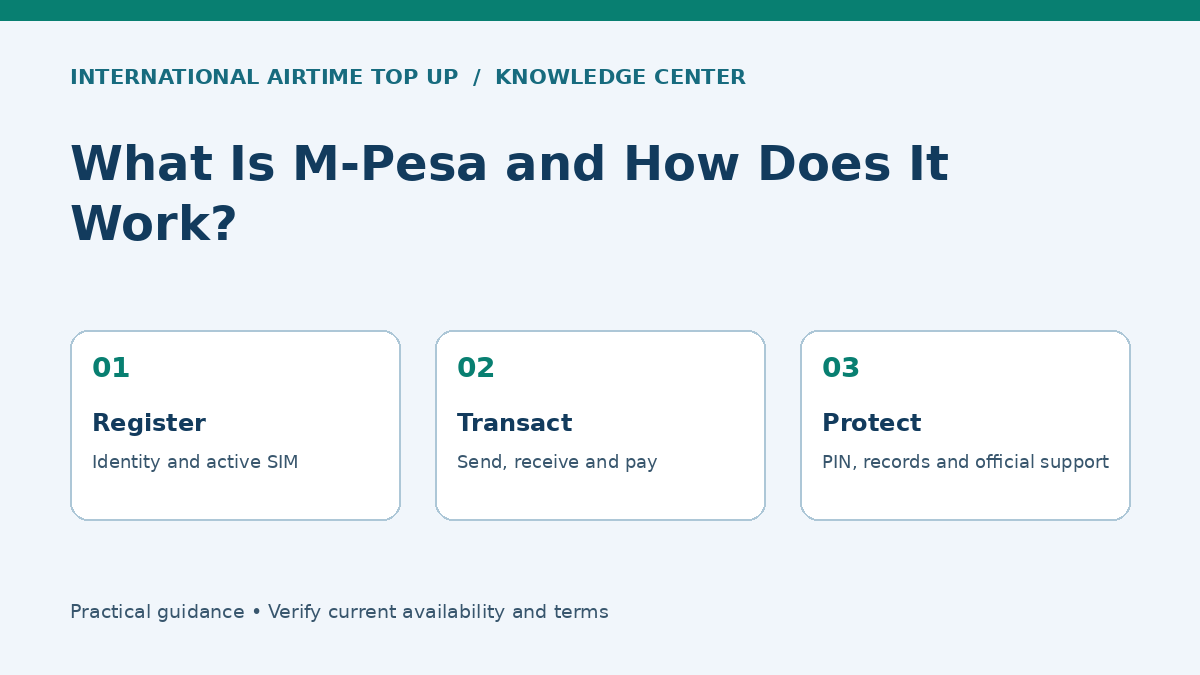
M-Pesa links an eligible mobile account to electronic value and a network of digital and agent services. Depending on the country, customers can deposit and withdraw through agents, transfer value, pay merchants or bills and receive supported remittances. M-Pesa is not one identical global product. Registration, menus, partner connections, transaction types, limits, charges and dispute procedures are set for each operating market.
Registration, PINs and transaction records
A customer generally registers under local identity and SIM requirements. The secret PIN authorises wallet actions and should be entered only through the legitimate interface; neither a sender nor an agent needs to know it. Official confirmations and the wallet’s transaction history help distinguish a real credit from a fabricated message. If a prompt requests reversal or onward payment, verify the underlying record and contact official support before acting.
Check route availability before entering payment details
“Available in the country” does not necessarily mean available for every sender, recipient or transaction. Confirm that the provider supports the sending country, destination, currency, amount, account type and a country-specific mobile-money service in the M-Pesa family. A route can be temporarily paused for maintenance, liquidity, regulatory review or partner reasons. Do not use a workaround suggested by an unknown person when the desired option is unavailable. Changing the declared purpose, splitting a transaction to avoid checks, or selecting an unrelated destination type can create delays and may breach provider terms or applicable requirements.
Read the live eligibility message before paying. If an operator, wallet or bank is not shown, ask official support whether it is unsupported or temporarily unavailable rather than guessing from an old article or social-media post.Collect and verify recipient information
The essential information is a properly registered customer whose available functions, limits and protections depend on the operating market. Copying data from a recent official record is safer than relying on memory. Read every digit and spelling back to the recipient through a trusted channel, especially after a rushed message or a request that arrives from a new number. Names should match the destination record as closely as the route requires. Mobile-number prefixes may not reliably prove the current network where portability exists. Bank names can be similar, and a valid account number does not by itself prove that the intended person controls it.
Never ask for a password, PIN or one-time authentication code. Those secrets authorise access; they are not normal beneficiary details. If a purported recipient or support agent asks for them, stop and contact the person or organisation through an independently verified channel.Compare total cost and usable value
Evaluate the sender’s total payment against the value the recipient can actually use. The economic cost can include a visible transfer fee, an exchange-rate margin, funding charges, destination deductions, withdrawal fees, transport to a collection point and the cost of delay. To compare providers fairly, obtain quotes close together for the same amount, funding method and delivery route. Record the total charged, destination amount, estimated availability and any disclosed third-party costs. A zero-fee label does not establish that a transfer is the lowest-cost option.
Illustrative scenario: one quote costs slightly more upfront but delivers more usable value and avoids a recipient journey; another advertises a lower fee but produces a smaller destination amount or requires paid cash-out. The better choice depends on the complete household outcome, not the headline fee alone.Follow a careful step-by-step process
1. Open the provider’s official website or application from a trusted device. 2. Select the correct destination and delivery type. 3. Enter recipient details exactly. 4. Review any displayed name or network result without treating it as a substitute for confirmation. 5. Enter the amount and read the complete quote. 6. Check the expected timing, expiry of the quote and cancellation conditions. 7. Pay only through the supported checkout. 8. Save the transaction reference and disclosure. 9. Share only the safe information the recipient needs. 10. Confirm receipt through the destination record before treating the matter as closed.
If a screen changes the destination type, recipient amount or operator after validation, pause and recheck the order. A minute spent reviewing the confirmation page is usually easier than attempting to correct a completed transaction.Plan for limits, verification and review
A transaction can be within one advertised limit yet exceed another. Possible constraints include per-transfer, daily, monthly, wallet-balance, account-level, sender, recipient, cash-out and partner limits. Limits can depend on verification level and may use calendar or rolling periods. Providers may request identification, source-of-funds information, transaction purpose or relationship evidence. A request is not proof of wrongdoing; it can be part of legal and risk controls. Upload documents only through an official secure channel and redact nothing unless the provider instructs you to do so.
Do not promise the recipient an exact delivery time while required information is outstanding. Respond promptly and accurately, but never send credentials or sensitive documents to a person contacting you through an unverified account.Interpret timing and status messages correctly
Delivery estimates depend on funding clearance, automated and manual checks, destination processing, cut-off times, weekends, public holidays, maintenance and correct beneficiary information. “Instant” or “minutes” should be understood as an eligible-case experience, not a universal guarantee. When a deadline matters, work backward from the time the recipient needs usable value. Allow space for verification and destination access. Sending at a branch closing time or immediately before a holiday can change a route that is ordinarily quick.
Track through the official page or application. Avoid repeated payment attempts simply because a status has not changed; duplicates can create a second valid transaction rather than accelerate the first.Use practical scenarios to choose well
Scenario 1 - urgent household support: the recipient needs value today. The sender checks whether a country-specific mobile-money service in the M-Pesa family is currently available, whether the recipient can use it immediately, and what time local access closes. Speed is assessed at the point of use, not only at provider dispatch. Scenario 2 - recurring support: a sender records the verified beneficiary details, typical total cost, support references and recipient access costs after each successful transaction. The information is rechecked rather than blindly reused because accounts, networks, limits and provider routes can change.
Scenario 3 - unexpected request: a relative appears to request urgent help from a new number. The sender verifies the story using a known number or another trusted person before paying. Emotional urgency does not override identity verification.Troubleshoot in a safe sequence
First identify the last confirmed stage: payment authorised, provider received funds, verification requested, destination processing, completed, failed, cancelled or refunded. Then compare the exact beneficiary details and ask the recipient to check the correct destination record rather than relying only on an SMS. If the estimate has passed, contact official support with the transaction reference, timestamps, amount and a concise description. Ask whether the provider needs action from the sender, recipient or destination partner. Keep screenshots that do not expose authentication secrets.
For a wrong number, wrong account or suspected scam, report immediately. Recovery may be difficult after value has been credited, collected, spent or withdrawn. Do not pay anyone who promises recovery in exchange for another transfer.Protect the account and the recipient
Use a strong unique password, multifactor authentication where offered, current device software and a network you trust. Type the official address yourself or use a saved verified application. Check the payee and amount before approving a bank or card prompt. The recipient should protect transaction messages, wallet PINs and collection references. Cash should be collected only at an authorised location. Neither party should disclose a one-time code to someone claiming that it is required to release an incoming payment.
After completion, review the transaction record for an unfamiliar change and retain it for the period needed for support, budgeting or applicable recordkeeping. Report suspicious contact using the provider’s published channels.Pre-transaction checklist
Confirm the destination country and currency; confirm the exact delivery method; verify the recipient through a trusted channel; compare the total sender payment and usable recipient value; review timing and access hours; check limits and identification; read cancellation and refund conditions; and save the final disclosure. For M-Pesa, also confirm that the selected destination is active and eligible at the time of sending. Do not assume that a previous successful transfer proves current availability.
If any essential fact is uncertain, postpone payment long enough to resolve it. A responsible provider should present the core quote and beneficiary information before final authorisation.Frequently asked questions
Is a country-specific mobile-money service in the M-Pesa family always available for M-Pesa?
No. Availability can depend on the sending country, provider, recipient account, currency, amount, verification level and current destination-partner status. Check the live route before paying.
What information should I confirm before sending?
Confirm a properly registered customer whose available functions, limits and protections depend on the operating market. Also verify the amount, currency, delivery method and how the recipient will access the value.
Does a completed status prove that the recipient can use the value?
It is strong evidence that provider processing finished, but the recipient should confirm the correct destination record and practical access. Contact official support if the record does not reconcile.
Can I cancel after payment?
Cancellation depends on the transaction stage, provider terms, route and applicable law. Contact official support immediately; recovery may be impossible after credit, collection, spending or withdrawal.
How can I reduce the risk of fraud?
Verify unexpected requests through a known channel, use the official service, protect passwords and one-time codes, review beneficiary details and report suspicious activity immediately.
Review the live options before sending
Check current availability, the complete quote and recipient requirements before authorising a transaction.
Explore available servicesAuthoritative sources
Information notice: This guide provides general educational information, not financial, legal, tax or regulatory advice. Availability, fees, exchange rates, limits, requirements and delivery times vary and can change. Review the current quote, provider terms and official destination guidance before proceeding.