How to Find the Correct Mobile Network Before Sending Airtime
A practical network-identification guide covering country codes, prefixes, number portability, provider detection limits and pre-payment confirmation.
By International Airtime Top Up Editorial TeamReviewed by International Airtime Top Up Editorial TeamPublished 2026-09-26Updated 2026-09-2621 min read
Understand how the transaction moves from sender to recipient
The sender normally chooses the destination and operator validation before an airtime or data purchase, enters beneficiary information, reviews a quote and funds the transaction. The sending provider validates the payment and required customer information before passing an instruction through its payout arrangement. A destination institution or mobile network then attempts the credit or makes the value available. These stages are separate. “Payment received” may mean the provider has the sender’s funds; “processing” may cover verification or routing; and “completed” should be checked against the recipient’s actual account, wallet, collection record or operator balance. Keep the reference until both parties have reconciled the result.
Conversion can also occur at different points. The quote should state the sending amount, transfer charge, exchange rate where relevant, and expected destination amount. If the quote is indicative rather than guaranteed, read the conditions that determine the final conversion.
Why prefixes are not conclusive
Numbering plans allocate ranges, but mobile number portability can allow a customer to retain a number after changing networks. Recycled numbers and provider routing data can create additional uncertainty. A prefix lookup is therefore a clue, not final proof. The recipient’s current operator information and a validated checkout result are stronger when they agree.
A reliable operator-check sequence
Select the country, normalise the number into the provider’s requested international format, ask the recipient for the current network and review any detection result. If the information conflicts, stop before payment. Do not test a network by making small speculative recharges. Confirm through official operator tools or support when the product cannot be validated.
Check route availability before entering payment details
“Available in the country” does not necessarily mean available for every sender, recipient or transaction. Confirm that the provider supports the sending country, destination, currency, amount, account type and operator validation before an airtime or data purchase. A route can be temporarily paused for maintenance, liquidity, regulatory review or partner reasons. Do not use a workaround suggested by an unknown person when the desired option is unavailable. Changing the declared purpose, splitting a transaction to avoid checks, or selecting an unrelated destination type can create delays and may breach provider terms or applicable requirements.
Read the live eligibility message before paying. If an operator, wallet or bank is not shown, ask official support whether it is unsupported or temporarily unavailable rather than guessing from an old article or social-media post.
Compare total cost and usable value
Evaluate the sender’s total payment against the value the recipient can actually use. The economic cost can include a visible transfer fee, an exchange-rate margin, funding charges, destination deductions, withdrawal fees, transport to a collection point and the cost of delay. To compare providers fairly, obtain quotes close together for the same amount, funding method and delivery route. Record the total charged, destination amount, estimated availability and any disclosed third-party costs. A zero-fee label does not establish that a transfer is the lowest-cost option.
Illustrative scenario: one quote costs slightly more upfront but delivers more usable value and avoids a recipient journey; another advertises a lower fee but produces a smaller destination amount or requires paid cash-out. The better choice depends on the complete household outcome, not the headline fee alone.
Follow a careful step-by-step process
1. Open the provider’s official website or application from a trusted device. 2. Select the correct destination and delivery type. 3. Enter recipient details exactly. 4. Review any displayed name or network result without treating it as a substitute for confirmation. 5. Enter the amount and read the complete quote. 6. Check the expected timing, expiry of the quote and cancellation conditions. 7. Pay only through the supported checkout. 8. Save the transaction reference and disclosure. 9. Share only the safe information the recipient needs. 10. Confirm receipt through the destination record before treating the matter as closed.
If a screen changes the destination type, recipient amount or operator after validation, pause and recheck the order. A minute spent reviewing the confirmation page is usually easier than attempting to correct a completed transaction.
Plan for limits, verification and review
A transaction can be within one advertised limit yet exceed another. Possible constraints include per-transfer, daily, monthly, wallet-balance, account-level, sender, recipient, cash-out and partner limits. Limits can depend on verification level and may use calendar or rolling periods. Providers may request identification, source-of-funds information, transaction purpose or relationship evidence. A request is not proof of wrongdoing; it can be part of legal and risk controls. Upload documents only through an official secure channel and redact nothing unless the provider instructs you to do so.
Do not promise the recipient an exact delivery time while required information is outstanding. Respond promptly and accurately, but never send credentials or sensitive documents to a person contacting you through an unverified account.
Interpret timing and status messages correctly
Delivery estimates depend on funding clearance, automated and manual checks, destination processing, cut-off times, weekends, public holidays, maintenance and correct beneficiary information. “Instant” or “minutes” should be understood as an eligible-case experience, not a universal guarantee. When a deadline matters, work backward from the time the recipient needs usable value. Allow space for verification and destination access. Sending at a branch closing time or immediately before a holiday can change a route that is ordinarily quick.
Track through the official page or application. Avoid repeated payment attempts simply because a status has not changed; duplicates can create a second valid transaction rather than accelerate the first.
Troubleshoot in a safe sequence
First identify the last confirmed stage: payment authorised, provider received funds, verification requested, destination processing, completed, failed, cancelled or refunded. Then compare the exact beneficiary details and ask the recipient to check the correct destination record rather than relying only on an SMS. If the estimate has passed, contact official support with the transaction reference, timestamps, amount and a concise description. Ask whether the provider needs action from the sender, recipient or destination partner. Keep screenshots that do not expose authentication secrets.
For a wrong number, wrong account or suspected scam, report immediately. Recovery may be difficult after value has been credited, collected, spent or withdrawn. Do not pay anyone who promises recovery in exchange for another transfer.
Mobile products are not interchangeable
Airtime, data bundles, wallet money and postpaid bill payments can use the same phone number while representing different products. Selecting the wrong category may create a valid but useless purchase. Confirm what the recipient needs and what the operator permits before focusing on denomination or speed.
Operator and plan eligibility matter
Country, number format, current network, prepaid or postpaid status, device, bundle conditions and account state can all affect eligibility. Portability means an old prefix may not identify the present network. Use current recipient information and the checkout validation; pause when they conflict.
Delivery confirmation needs the right record
An SMS can be delayed or overlooked. The recipient should check the operator balance or bundle record through an official method and distinguish general credit from a separate allowance. The sender should retain the provider reference and status. Together these records show whether the issue is notification, product placement or delivery.
Restrictions should be explained before purchase
Validity, automatic activation, promotional eligibility, roaming use, conversion rules and reversibility vary. A product description should be read as part of the transaction, not after it. When the recipient’s need is uncertain, ask first; top-ups can be difficult to reverse once accepted.
A realistic scenario
A number begins with a range historically associated with one operator, but the owner ported it. The recipient’s current network conflicts with a prefix website. The sender trusts current confirmation and checkout validation, pauses when detection differs, and avoids testing the guess with an irreversible recharge.
Questions the scenario should answer
Could the recipient use the value at the required time, and did both parties understand the relevant identity, account, product and access requirements? Was the total cost and risk acceptable, was confirmation obtained from an official record, and would the evidence support a clear complaint if something went wrong?
Focused review: Find the Correct Mobile Network Before Sending Airtime
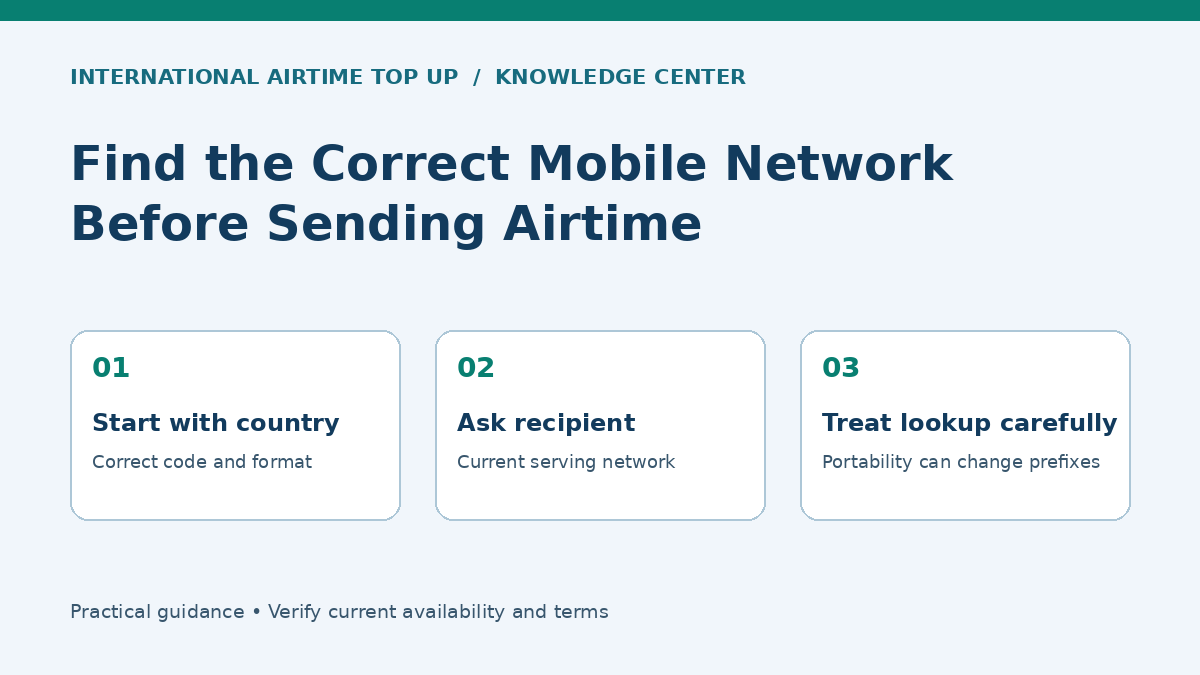
The central question for this guide is the correct serving mobile network for a recipient number. The relevant service or decision is operator validation before an airtime or data purchase. A reader should finish with a practical understanding of a practical network-identification guide covering country codes, prefixes, number portability, provider detection limits and pre-payment confirmation. The three topic-specific control points are start with country: correct code and format; ask recipient: current serving network; and treat lookup carefully: portability can change prefixes. These points should be checked against the live provider or operator information because eligibility and operating conditions can change.
Search intent and decision intent
People may reach this page using phrases such as find mobile network, check phone network, mobile number portability airtime, operator lookup, correct network top up. Those searches can represent different needs: basic education, comparison before purchase, help with a failed transaction or verification of a suspicious request. The correct response starts by identifying which need exists. For this topic, the decisive beneficiary information is the destination country, complete number, current network, portability status and eligible prepaid product. A page view should not be treated as a live quotation, eligibility confirmation or legal instruction; the current transaction screen and official source remain controlling.
A deeper way to frame the decision
The central objective of this guide is to identify the intended recipient’s live serving network prior to selecting an operator-specific top-up. That sounds simple, but a cross-border instruction joins decisions about identity, technology, service rules and the intended recipient’s real circumstances. A good result is not merely a successful payment screen. It is a correctly directed instruction that produces value the intended person can recognise and use under the stated conditions.
To identify the intended recipient’s live serving network prior to selecting an operator-specific top-up, begin with the underlying facts and work backwards from the decision or problem being examined. The operational route may involve intended recipient confirmation supported by careful number formatting and any validated operator-detection result. Each participant can apply its own validation, availability rules and processing state language. Separating these stages prevents the customer from blaming the wrong party or taking an action—such as paying twice—that makes reconciliation harder.
The most central avoidable risk is relying only on the original prefix in a market where mobile-number portability is accessible. The practical response is deliberate preparation: confirm the destination facts, read the live quote or product description, retain the reference and agree with the intended recipient on how receipt will be checked. This approach remains useful even when providers, prices and corridor availability change.
Detailed preparation prior to starting
Preparation should cover destination country, international number, domestic prefix rules, live SIM, recent porting and the network name shown at checkout. Do not treat those items as clerical details. They determine whether the route can identify the right destination, apply the right product rules and give customer service teams enough supporting proof if something goes wrong.
Ask the intended recipient to provide live records rather than relying on an old transfer, saved contact or screenshot. Names, phone numbers, networks, accounts, wallets and identification can change. Read the records back using unambiguous grouping, and distinguish the destination-country code from a domestic trunk prefix. Where a form supplies an example, compare the structure rather than copying the example itself.
Prepare through the official service, not through a link supplied in an unexpected message. Check the presented legal or trading identity, sign in through a known address, protect passwords and one-time codes, and avoid uploading documents over informal messaging channels. If a service asks for additional supporting proof, use the secure channel identified in its application or official customer service material.
State the intended recipient’s intended outcome in one sentence prior to selecting a product.
Confirm destination details directly with the intended recipient through a trusted channel.
Review the live amount, currency, fees, rate or denomination prior to authorisation.
Save the reference, receipt and exact processing state wording without exposing security credentials.
Agree on when and how the intended recipient will confirm practical access to the value.
A complete decision framework
A useful comparison should include intended recipient supporting proof, handset display, operator message, portability history, lookup confidence and checkout validation. These factors should be considered together because a route that performs well on one measure can be unsuitable on another. A low visible fee can coexist with an exchange-rate difference; a rapid digital processing state can coexist with an intended recipient access problem; and a familiar option can become inconvenient if account, network or identification circumstances have changed.
Use a simple worksheet with one row for each genuinely accessible option. Record only records shown in the live quote, official terms or intended recipient confirmation. Separate facts from assumptions and mark unknown items for checking. This reduces the tendency to choose the first option presented or to rely on a service’s general marketing statement instead of the instruction-specific result.
The intended recipient should participate in the comparison. Senders often know the funding side, while recipients understand local access, network reliability, travel distance, identification, liquidity and safety. A short conversation can reveal a constraint that no price table shows. The best practical route is the one that works at both ends, not simply the one that is easiest to initiate.
End-to-end walkthrough with control points
At the quotation stage, enter only the minimum records needed to see live availability and the expected outcome. Check the sending amount and intended recipient amount or product value, all separately disclosed charges, currency, payout method and any timing qualification. If a quote expires, obtain a fresh one rather than assuming the former terms remain accessible.
At the data-entry stage, verify destination country, international number, domestic prefix rules, live SIM, recent porting and the network name shown at checkout. Pause at the final review screen and compare it with the intended recipient’s message or trusted record. Do not mentally right an error presented on screen; go back and edit it. Screenshots may help with non-sensitive details, but never capture or share passwords, full payment credentials or one-time security codes.
After authorisation, record the service reference and follow the service’s stated processing state channel. Ask the intended recipient to check the right destination—not merely a general notification. A completed processing state should correspond with a balance, account entry, collectable transfer or other usable outcome. If the two records disagree, preserve both and contact official customer service with a precise timeline.
Practical scenario: applying the framework
A familiar prefix suggests one operator, but the intended recipient confirms that the number was ported several months earlier. The customer first states the required outcome and asks the intended recipient what access is accessible today. They compare the live options rather than assuming the route used last time is still appropriate. Prior to payment, they check the destination details, conditions and expected intended recipient value, then keep the reference and ask for confirmation at the right endpoint.
The lesson is not that one route is universally preferable. It is that identify the intended recipient’s live serving network prior to selecting an operator-specific top-up requires alignment between the customer instruction, the service’s supported route and the intended recipient’s circumstances. If any of those three elements is uncertain, the customer should resolve the uncertainty prior to authorisation rather than hoping that customer service can repair a completed instruction.
A second lesson concerns supporting proof. When the customer can provide the exact reference, time, amount, destination and presented processing state, customer service can investigate more efficiently. Vague descriptions such as “it did not work” omit the records needed to locate the instruction. Good record keeping is therefore part of safe sending, not an administrative task to consider only after failure.
Edge cases and changing circumstances
Edge cases often arise when right records becomes outdated between preparation and delivery. A number may have been ported, a wallet may have reached a limit, an identification document may have expired, an account may be restricted, an outlet may lack liquidity, or a product may have been withdrawn. The customer cannot eliminate every change, but can reduce exposure by confirming central facts close to payment time.
Another complication is the multi-party route: intended recipient confirmation supported by careful number formatting and any validated operator-detection result. One system may show an accepted instruction while another has not yet acknowledged fulfilment. Processing state labels should be read literally and in context. “Submitted,” “processing,” “sent,” “accessible,” “completed,” “failed,” “cancelled” and “reversed” may describe different operational stages rather than interchangeable outcomes.
International boundaries also introduce differences in time zones, working days, maintenance windows, currencies, consumer-protection processes and data requirements. Avoid importing expectations from one corridor into another. The live instruction page and destination instructions take priority over a general recollection, and customer service should clarify ambiguous or contradictory records prior to another payment is attempted.
Troubleshooting without creating a second problem
Troubleshooting should proceed from observation to verification and only then to action. First, record the exact processing state and last known successful step. Second, check the intended recipient destination and ask what the intended recipient can actually see. Third, review any service request or notification. Fourth, contact official customer service with the reference and supporting proof if the processing state exceeds the stated expectation or the records conflict.
Do not respond to relying only on the original prefix in a market where mobile-number portability is accessible by repeatedly resubmitting. A duplicate may complete after the original, create two charges or complicate a reversal. Likewise, do not change several variables at once. If the intended recipient detail, product and payment method are all changed, it becomes difficult to identify the cause. Controlled troubleshooting makes one justified change after the previous processing state is understood.
When customer service is involved, describe the issue chronologically: what was intended, what was entered, what was paid, which processing state appeared, what the intended recipient observed and what remedy is requested. Keep communication in the official case thread. If the service gives a timeframe, note its start point and whether it refers to investigation, reversal, refund posting or final intended recipient access.
Safety, privacy and supporting proof
A genuine customer service investigation may require instruction facts, but nobody needs the customer’s password or one-time authentication code. Treat an unsolicited request to move the conversation to a private social-media account, install remote-access software, pay a release charge to an unknown destination or reveal security credentials as a warning sign. Return to the service through a known official channel.
Store receipts and identity documents proportionately. A instruction reference and redacted proof may be useful, whereas distributing full documents across email threads and messaging applications creates unnecessary exposure. Review the service’s privacy notice and document-upload method. On a shared device, sign out, remove downloaded documents and avoid saving payment credentials without informed consent.
Supporting proof should be accurate and unaltered. Keep the original receipt, timestamp, processing state and correspondence. If a screenshot is used, include enough context to show the service and stage while masking unrelated personal or financial data. Never manufacture or edit supporting proof to accelerate a review; inconsistent records can delay resolution and may trigger further verification.
Intended recipient-centred review after completion
Completion should be assessed from the intended recipient’s perspective. Ask whether the value reached the right destination, whether it is accessible rather than merely notified, whether the amount or product matches the expectation, and whether any action is needed prior to use. A message received by the customer is not a substitute for the intended recipient checking the relevant balance, wallet, account or collection instruction.
If the outcome is right, retain the reference for an appropriate period and note any lesson that would make the next instruction safer. If something differs, avoid instructing the intended recipient to spend, withdraw or transfer the value while an error is being investigated. Report the discrepancy promptly and describe it precisely, including whether the issue concerns identity, amount, currency, destination, product, access or processing state.
The review should return to the original objective: identify the intended recipient’s live serving network prior to selecting an operator-specific top-up. That prevents a narrow focus on the service’s processing state alone. A technically completed instruction can still require intended recipient guidance, while a delayed processing state may resolve without intervention. Combining system supporting proof with intended recipient supporting proof gives the clearest picture.
Questions to ask prior to authorising
A disciplined customer can convert this guide into a short pre-authorisation conversation. What exactly does the intended recipient need? Which destination is active today? What identity, account, wallet, network or collection condition applies? What will the intended recipient receive or be able to use? Which costs, limits and timing qualifications are shown? Who will be contacted if the result differs?
For this topic, the decisive records includes destination country, international number, domestic prefix rules, live SIM, recent porting and the network name shown at checkout. If the customer cannot verify a critical item, postponing is usually safer than guessing. Urgency may be genuine, but it does not make a wrong number, mismatched name, unsupported wallet, unsuitable product or fraudulent request easier to recover.
Finally, ask whether the instruction makes sense in the context of the relationship and prior activity. An unusual beneficiary, abrupt change of instructions, secrecy demand, unexpected intermediary or pressure to ignore warnings deserves independent confirmation. Verification is not distrust of the intended recipient; it protects both parties from mistakes, impersonation and compromised accounts.
Can the intended recipient use this exact form of value now?
Have the destination details been confirmed independently?
Does the final screen match the intended amount, product and currency?
Are timing statements estimates, guarantees or conditional ranges?
Is there a clear official customer service and complaint route?
Have the reference and non-sensitive supporting proof been retained?
How to use this guide over time
Prices, limits, eligibility, operator catalogues, supported corridors and verification practices can change. Use this article as a decision framework, then confirm live instruction facts with the relevant service and intended recipient. Avoid turning an illustrative scenario into a promise about a particular country, network or delivery time.
The stable principle is to compare intended recipient supporting proof, handset display, operator message, portability history, lookup confidence and checkout validation. Recording these factors creates a repeatable process that can be used even when the accessible brands or interfaces change. It also supports better learning: after each instruction, note which assumption was right, which records was hard to obtain and which control prevented an error.
For recurring customer service to family or business contacts, review saved beneficiaries periodically and delete obsolete records. Reconfirm details after a long gap, handset or SIM change, account change, relocation or reported fraud. Familiarity should reduce effort through better records, not through skipping the controls that keep a instruction accurate and safe.
Frequently asked questions
Is operator validation before an airtime or data purchase always available for the correct serving mobile network for a recipient number?
No. Availability can depend on the sending country, provider, recipient account, currency, amount, verification level and current destination-partner status. Check the live route before paying.
What information should I confirm before sending?
Confirm the destination country, complete number, current network, portability status and eligible prepaid product. Also verify the amount, currency, delivery method and how the recipient will access the value.
Does a completed status prove that the recipient can use the value?
It is strong evidence that provider processing finished, but the recipient should confirm the correct destination record and practical access. Contact official support if the record does not reconcile.
Can I cancel after payment?
Cancellation depends on the transaction stage, provider terms, route and applicable law. Contact official support immediately; recovery may be impossible after credit, collection, spending or withdrawal.
How can I reduce the risk of fraud?
Verify unexpected requests through a known channel, use the official service, protect passwords and one-time codes, review beneficiary details and report suspicious activity immediately.
Review the live options before sending
Check current availability, the complete quote and recipient requirements before authorising a transaction.
Information notice: This guide provides general educational information, not financial, legal, tax or regulatory advice. Availability, fees, exchange rates, limits, requirements and delivery times vary and can change. Review the current quote, provider terms and official destination guidance before proceeding.
A regional guide to international mobile recharge across Africa, covering number formats, operator checks, airtime versus data and delivery confirmation.